‘Innocence Lost’ Treads Lightly
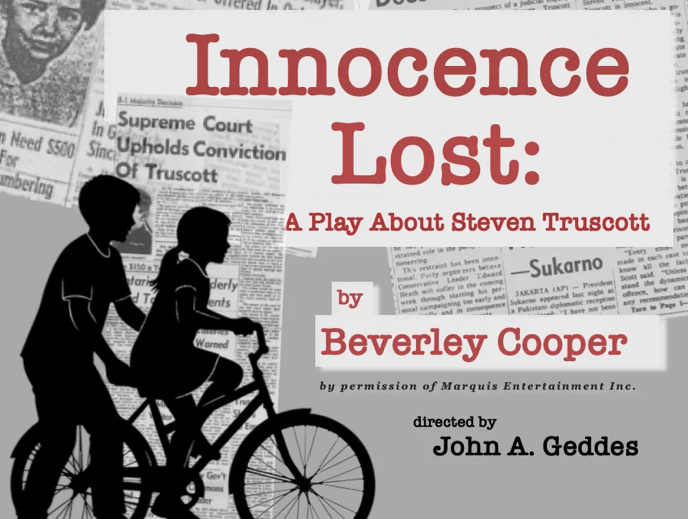
Content Warning: ‘Innocence Lost: A Play About Steven Truscott’ concerns real-life events of murder, sexual assault, and crimes committed against children. Although these topics are not discussed in-depth in this review, they feature heavily in this production.
How well do you know your neighbors? A dramatic rendition of the harrowing case of Steven Truscott, one Canadian play presents a grueling analysis of the justice system and a forewarning of the dangers of misinformation. Written by Beverley Cooper and put to the stage by Kingston’s own Domino Theatre, Innocence Lost: A Play About Steven Truscott handles the heavy subjects of child murder, sexual assault, and execution. These sensitive topics are discussed in graphic detail and should be considered before viewing this show.
On June 9, 1959 in Clinton, ON, Steven Murray Truscott (14 years old) gave Lynne Harper (12 years old) a ride up to the County Road on his bicycle. Upon his wave goodbye, Truscott became the last known person to see Harper alive. On June 11, 1959, searchers discovered her body in the woodlot of a nearby farm. Truscott was convicted and sentenced to death by hanging in September 1959 for Harper’s murder— his execution was later pardoned. Five decades later, in 2007, his conviction was overturned on the basis that primary forensic evidence was overblown in trial, and significant evidence supporting Truscott’s innocence was withheld from his defense team.
To hold such a grievous history in one room is a heavy task, undertaken with ambition by Domino Theatre’s design team. The set was layered in three tiers, playspace occupying the steps with each platform moving up from the next like a vertically-challenged set of stairs. The space was painted as a proscenium “black box” peppered with tables, chairs, and hooks upon which actors traded their costumes. An awkwardly-oriented projection occasionally found its way to the upper left side of the back curtain to provide historical context and display evidence.
The stage was realized to its full potential by director John A. Geddes: actors were always in perfect eyeline, visible to all. Cast members remained onstage for the entire show, though the main action pulled necessary focus, and each actor handled the stage time with ample aplomb. Lighting by Adair Redish played a big role in discerning which character is most relevant at a given moment, but the overall impression of the lighting environment seemed almost strictly utilitarian. There was little opportunity taken for any sort of artistic approach to the visuals– even the blocking tableaus seemed purely functional in all regards. A beautiful and operational set up of lightbulbs simply hung suspended from the ceiling for the duration of the performance, leaving their artistic function unclear.
Costumes by Liz Schell were connotative by design: implying occupation, social standing, and time period. The characters’ identities were held loosely by most as they transitioned from persona to persona, but firmly by those few actors that remained in one character at all times. The latter group of characters were handsomely outfitted in costumes of vague historical accuracy.
The backbone of the cast was Racheal McDonald— “Actor 10.” Her depiction of Doris Truscott was closely connected to the play’s history; she was achingly disbelieving, bafflingly scorned, and vexed by injustice. McDonald was a lighthouse of clarity along the rocky shores of this production. Ashlee Miller was a sturdy protagonist as “Actor 1/Sarah.” Though Sarah was a purely fictional character created for the script, Miller managed to solidify her place within the story. Mitchell Mayne as “Actor 7” was a charming and distinct character actor, and Barry Yuen as “Actor 5” was an eye-catching performer, bringing a sense of variety to the play.
Though the actors all brought their own individual flair, the collective performance made for a confusing watch. This play is extremely reliant on its ensemble: characters trade spaces in the spotlight as narrator, and move the play forward through alternate descriptions, rumours, and “testimonies” concerning the Truscott case. Despite never missing a cue, there was no strong artistic stance adopted to elevate the ensemble performance to one of true cohesion. The rise of the whispers could have been employed to a higher degree, fixating on the dangers of the rumour mill and investigative tunnel vision– in short, the stakes (and the pitchforks) could have been sharper. Innocence Lost: A Play About Steven Truscott carries itself through a flurry of misinformation; however, the blizzard effect was reduced to that of an inscrutable fog.
This play lives within the blur of truth and fable, however, the directionless enactment makes for a questionable tone that leaves audiences confused. This is not a fault restricted to Domino Theatre’s enactment: I am skeptical of Cooper’s playwriting. The script contains little exploration of the actual trial of justice– the focus remains instead on town gossip. The play itself is a twister of unsurety: Cooper briefly delves into the class issues and hierarchies constructed by rank among the army base, and loosely toggles with the gender bias present through a reference to the “all male” jury. However, such leads are not often followed.
The script of Innocence Lost: A Play About Steven Truscott relies on the tragedy of its inspired events, requiring the associated emotions of the true story to provide literary merit. The assumption that merely gesturing toward the weight of subjects like classism, gender based violence, sexual assault, and murder is all the script needs to do to offer a profound take on the topic is misguided, and results in a blunted tribute to a real-life tragedy.
The play seems intended to make audiences feel as confused and convicted as the townspeople were, but presenting itself as a drilling exploration of a true story where justice was thwarted is wrong. The responsibility of narrative is a subject extremely relevant to the very making of this play: concocting a dramatized idea of a real murder case is what the townspeople did, and now, Cooper does the same.
A story dealing with such complicated topics should be unbowed in its stance and undertaking. However, both script and enactment feel lackluster in intention. Innocence Lost is lost alright, but the way home is not so far out of reach— with the implementation of a clear vision, this play could stand upright again.
Innocence Lost: A Play About Steven Truscott played at the Domino Theatre until October 31st, 2026. For more information, click here.