A Performer’s Journey ‘Into The Woods’ with Queen’s Musical Theatre
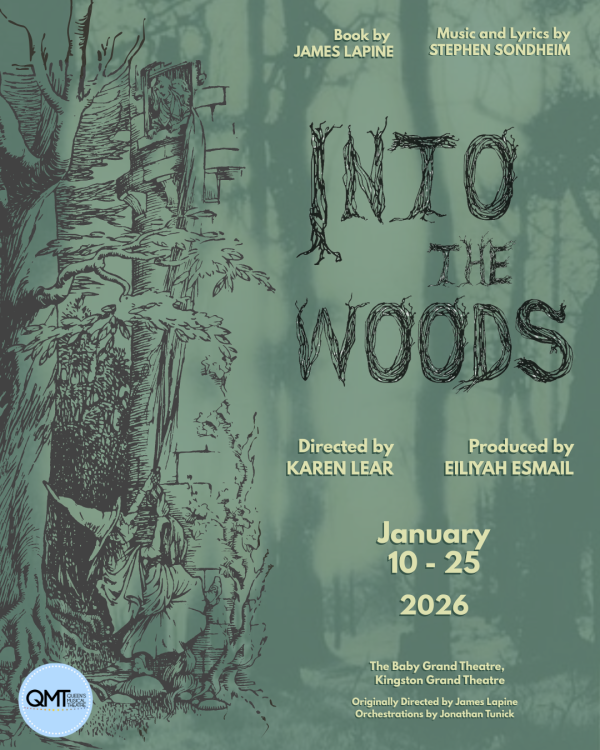
The production process behind student-run theatre is, in my experience, utterly unique from most amateur creation environments. The happenings behind the scenes of Queen’s Musical Theatre’s (QMT) Fall 2025 production of Into The Woods (music and lyrics by Stephen Sondheim, book by James Lapine) is no exception. Opening this week at the Baby Grand Theatre, this production is one I’ve had the privilege of performing in, providing me an opportunity to give a glimpse behind the curtain on a student-led production of one of Sondheim’s classics.
The rehearsal process took place almost entirely in Theological Hall on Queen’s campus, home to the university’s drama students. The rehearsal room features: a cast of 23 students, including five offstage swings covering anywhere from one to four roles and four onstage swings covering multiple roles, six assistant stage managers, two vocal directors, one stage manager, and one director. As one could expect with such a large team of students, you could certainly say full cast rehearsals are rowdy. Between learning complex vocal lines and navigating blocking entrances, members of the rehearsal team brainstorm silly names for the Baker (Linden Imeson Jorna) and Baker’s Wife’s (Mo Kelly) child, poke fun at the absurd logic of our classic fairytale characters, and tease one another’s reactions to the process in our Instagram group chat. Tossing jokes across the room sometimes results in pauses, as actors and creative team members alike take a moment to compose themselves, but there always comes a moment where everyone brings their attention back when needed most. Scheduling this volume of people alone (a feat handled by Stage Manager Quinn Hammond) also comes with its comedic moments: one such example was a full cast choreography rehearsal that took place midday on Queen’s Homecoming, with nearly every cast and creative team member dressed head to toe in tricolour as we put together the finale of Act One. In short, there is truly never a dull moment.
Beyond the rehearsal room, another difficulty for this company of students, as well as the small, but mighty live band (led by the only non-student involved in the production, Michael Capon, with assistance from Sully Franks) is the feat of balancing 17 performances over three weeks—the most in QMT’s recent history. It is a daunting run, especially for many student performers who study full-time in various programs, and have part time employment to support their schooling. As such, our many swings and covers are essential to ensure a smooth run amidst what is certain to be a frigid Kingston winter.
Despite QMT’s inability to rent a performance space on Queen’s campus this year and the concerns around performing in a space further out in the Kingston community, which can be a limitation for student ticket-buyers, we are fortunate to be staging Into The Woods in the Baby Grand Theatre. A recent haven for student-run theatre groups at Queen’s, the Baby Grand is intimate, with actors and audiences closer to one another than in a traditional, elevated proscenium style stage. The pushing of these boundaries between performers and audiences uplifts the vision for the production, but fitting a large cast on a small stage can still remain a challenge, one that was further heightened during our Designer Run. A Designer Run is the first chance for the board of the club, designers, and all others working on the show to see it fully rehearsed and blocked so they are able to give notes and apply changes as needed. With limited spaces on campus to rehearse and fit a production team of over 100, we were left performing in a lecture hall, the stage around 11 feet wide and seven feet across (a generous estimate). There was little room for the entire cast to even share the same space at the same time, let alone perform the blocking learned, especially as the show is not in a proscenium staging.
Throughout the process, the team shifted between rehearsing numbers in proscenium versus the split, two-audience-bank staging that the show will be performed in, due to the difficulties around changing rehearsal spaces. Ultimately, by the final month of rehearsals, each runthrough featured staging that replicated the space in the Baby Grand, giving actors the opportunity to play in a space truer to what the performance environment would look like.
Our director, Karen Lear, worked to ensure the show’s numbers remained dynamic despite the challenges. This began in our first character work rehearsal, where we gathered in a lecture space and walked around imaginary woods, given prompts to guide our character’s intentions throughout the duration of the rehearsal. The combination of these early intentions with Lear’s knowledge of the space, as an actor who previously performed with QMT in the Baby Grand, guided her care for sight lines and highlighting moments of importance within the show. I had the unique opportunity to see into her process even earlier on than most, as we share a closer relationship than just working on the same show—we also happen to be dating. As the production process began, many of our typical movie nights turned into wondering if we could watch yet another production of Into The Woods, and I watched as she’d come up with endless ideas to implement into the production process, filled with infectious excitement.
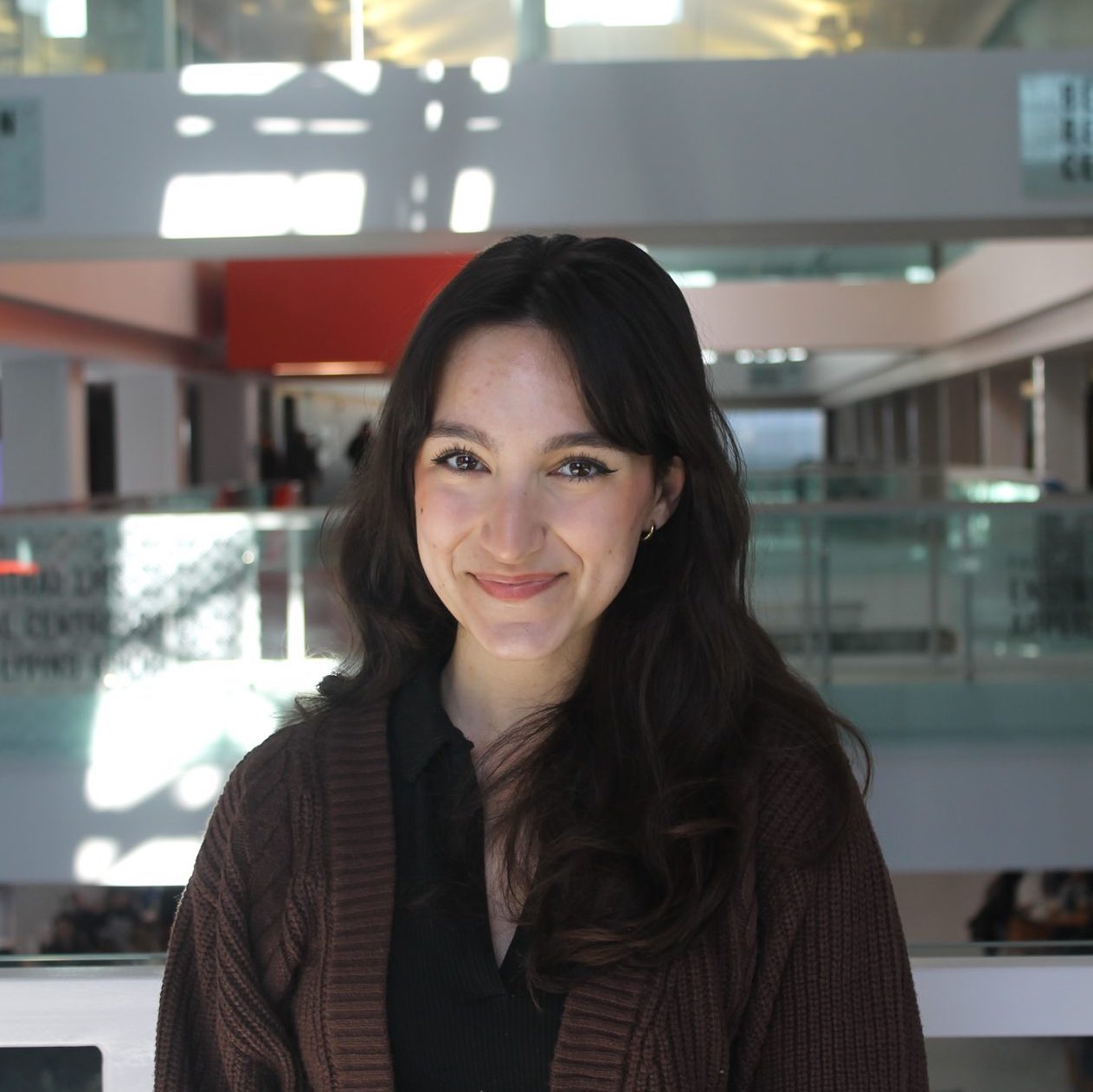
Lear made frequent offers and inquiries to actors regarding character backstories and choices. Her work was supported by vocal directors Joey David Harvey and Lauren Faria’s approach to teaching the score. They reminded actors to use their vocal quality and timbre to convey the stories of their characters as early as when the cast learned the opening ‘Prologue.’ This provided us as performers a foundation to build upon our character arcs throughout the duration of the musical. In these ways, the team provides actors with notes as necessary, while leaving space for us to experiment. Even as a performer who has loved the show for years, I found myself taking something new from each rehearsal, learning more and finding nuances in the many characters who make up the production—a feeling I suspect resonates with many of my castmates. One of these realizations was a deeper understanding of the connection between Little Red Riding Hood (Hannah Clark) and Cinderella (myself) in the story, two characters who do not directly interact with each other until Act Two. But throughout, they share immense parallels; both lose their mothers at young ages, are deceived by a man who appears in their lives, and appear entirely alone throughout most of the story. Yet ultimately, their shared identities collide in the penultimate number, ‘No One is Alone,’ a completion of their arc into young women.
One of my favourite rehearsal moments took place while learning the vocals for this song. In the 45 minute vocal rehearsal, we only sang it through twice—the first attempt was a “crash and burn.” This meant a sing-through of the piece before taking a closer look at the harmonies with Harvey and Faria, followed by a brief glance at the sections that needed work before our next attempt. After clarifying our notes and rhythms, Harvey wanted to try something different.
As Little Red and Cinderella perform this number with the Baker and Jack (Beckham Meredith), the cast in the room took up a formation. I faced Clark and Alice Graham (Little Red Swing), and stood back to back with Jorna and Ari Freedman (Baker Swing), who faced Meredith. Our Cinderella Swing, Zora Jajic, had a conflict and was unable to join us for this rehearsal.
“Sing it to each other,” Harvey said.
And just like that, before having ever blocked the scene, we stood singing each part to one another. I can’t comment on the experience of those singing the Baker and Jack parts. But I can confirm that there wasn’t a dry eye between myself, Clark, and Graham the entire span of our second pass of the song.
This connection between us—performers, yes, but peers, too—is the magic of student theatre. It’s in the moments of total harmony between cast and production, young person to young person, during a time of our lives that is so brief and fleeting, but incredibly influential. And how special it is that these moments are created entirely by ourselves.
After a pause on rehearsals for the Queen’s exam period, tech week is underway, and opening night is on the horizon. Soon enough, audiences will venture Into The Woods with this company and team. I could not be more grateful for my experience, spent with these people, this story, and with the deepest admiration for the hard work of over 100 students: students who remind me that no matter how uncertain things may feel in our corner of campus and the world beyond, no one is alone, truly.
‘Into The Woods’ is presented by Queen’s Musical Theatre, and will be playing from January 9 to 25 at the Baby Grand Theatre. Tickets and more information can be found here.