A Triumph of Terror
Content Warning: ‘Carrie’ deals with child abuse, violence, murder, and bullying. Although this review does not discuss these topics in depth, they are general themes in the performance.
In the effort of full transparency, let me open this review of Queen’s Musical Theatre (QMT)’s Carrie by disclosing my bias: the show is directed by Michaela Tassone, a KTA theatre critic with whom I have a professional relationship. Usually in cases where our writers know people involved in the work they’re reviewing, I encourage them to refrain from discussing that person’s role in the show. However, I believe a biased review touching upon Tassone’s directorial achievement would still be more authentic than an unbiased review ignoring her work, and so that is the review I have written.
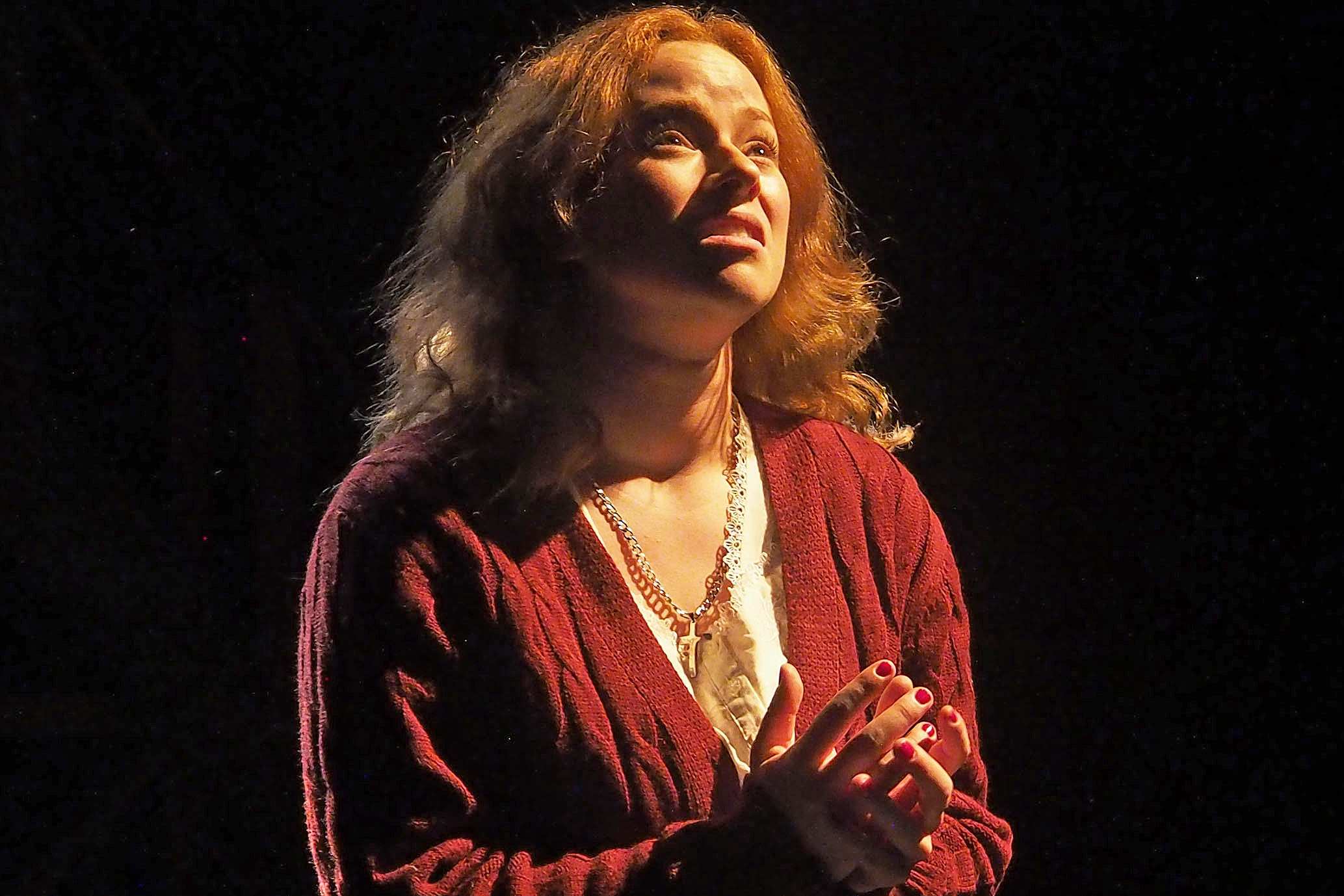
Carrie, based upon the Stephen King novel of the same name, opened on Broadway in 1988 to negative reviews. It closed after only 16 previews and five performances. Watching QMT’s production of Carrie, I struggle to wrap my head around its Broadway flop. Perhaps the 80s just weren’t ready for Carrie, but QMT most certainly was.
After an opening number full of high energy and dynamic choreography (Sophia Ingalls), Carrie’s first appearance needs to be able to steal back the spotlight, and Mo Kelly’s larger-than-life voice manages this task easily. The most remarkable aspect of Kelly’s performance is the dichotomy she brings to the role, contrasting her commanding, self-assured singing with the timid speaking voice of an insecure teenager.
Though Carrie has been a horror icon for decades, her mother Margaret, played by Karen Lear, was the truly frightening character. Despite being difficult to hear in some moments, what Lear lacks in volume she makes up for in intensity, often adopting a haunting thousand-yard stare while singing, and never needing more than just her severe presence to completely shift the tone on stage.
Other characters include Jeneviève Malyon’s Chris, who reveals the mundane horror of how awful teenage girls can be, while her friend Sue, played by Martina López, works in vain to undo the cruelty she partook in because “all the girls were doing it.” There’s also the gentle and kind Tommy, played by Connor Houghton, who stands in sharp contrast with brash class clown Billy, played by understudy Charles Kilby, who helps bring both the comedy and the pig’s blood.
The ensemble members rounding out the cast each felt like whole characters unto themselves. The background busywork was believably intentioned, and they were always doing something, whether they were on stage or off. There was the sense that even out of sight, the actors never fell out of character. I’d like to give a particular nod to Kara Zidar’s Stokes, whose behaviour during prom had me in stitches.
Choosing to use a thrust stage for Carrie leaves little room for error, but Tassone rose to the occasion. As with all thrust shows, I sat over on the side to better test the blocking, and I was not disappointed. Audiences could always see the faces of at least half of the characters on stage, and the actors never stayed stationary for too long.
However, the inherent nature of a properly-blocked thrust stage is what often made it hard to hear the actors. To project a voice over the musical accompaniment, it matters a great deal what direction a singer is facing. Unfortunately, the only way for the un-mic’ed cast to be heard by all three sides of the audience would be with bad blocking. If Tassone realized this (and I presume she did), I’m glad she prioritized sightlines over vocal balance, but still ensured the actors switch sides during their songs to give each audience bank a chance to hear the vocals at full volume.
The focal point of the set design (Myra Chiu) was two staircases pressed together in a triangle against the back wall. The set could quickly be changed by pulling the staircases apart, a white door easily swinging on its hinges to turn the space between both stairs into a doorway. Unfortunately, the door sometimes swung a little too easily, never quite holding its position and falling ajar when a character knocked upon it gently.
Megan McDonell and Alistair Leong’s lighting design was particularly good. I was impressed by a scene in which two duos—Chris and Billy, Sue and Tommy—are both plotting distinctly different schemes, and the colours illuminating them are equally as distinct. Sarah Boehmer’s sound design also stood out, especially the naturalistic way certain effects—like the approaching storm or the white noise of a tape recorder—grounded this supernatural show in reality.
The show’s tangible feeling was further aided by Jonas Jacobson’s costume design. From Carrie’s clunky black Mary Janes to her buttoned up cardigan, she looked exactly like a child dressed by their overbearingly religious mother, and seeing Margaret enter in a strikingly similar outfit only underlined the control she has over her daughter. While the prom dresses in Act II all stood out as too modern for the late-70s, they were all at the very least similarly anachronistic.
Even if audience members know how Carrie’s prom night ends—as I’m sure most do—the finale is still sure to shock. It is choreographed and blocked with an exacting precision that leaves nowhere to run. The cast, lights, and sound effects work in tandem to harness a feeling of terror that is unique to the close proximity of a black box theatre.
But even with the big spectacle of the finale, it is through the smaller details that Carrie really comes together. It’s the little touches—the singing from offstage, the nearly complete lack of dead air, the fiery orange light that seemingly glows off the staircase’s black paint—that sell the show. From Sue Snell already sitting nervously at centre stage when the audience walks in, to the way Carrie hunched in pain mirrors her mother hunched in prayer, it’s easy to see the level of care that went into this production.
Queen’s Musical Theatre’s ‘Carrie’ is playing at the Baby Grand Theatre until April 19th. Learn more and grab tickets here.