An Insatiable Curiosity: ‘The Silk Lining’s’ Cautionary Tale
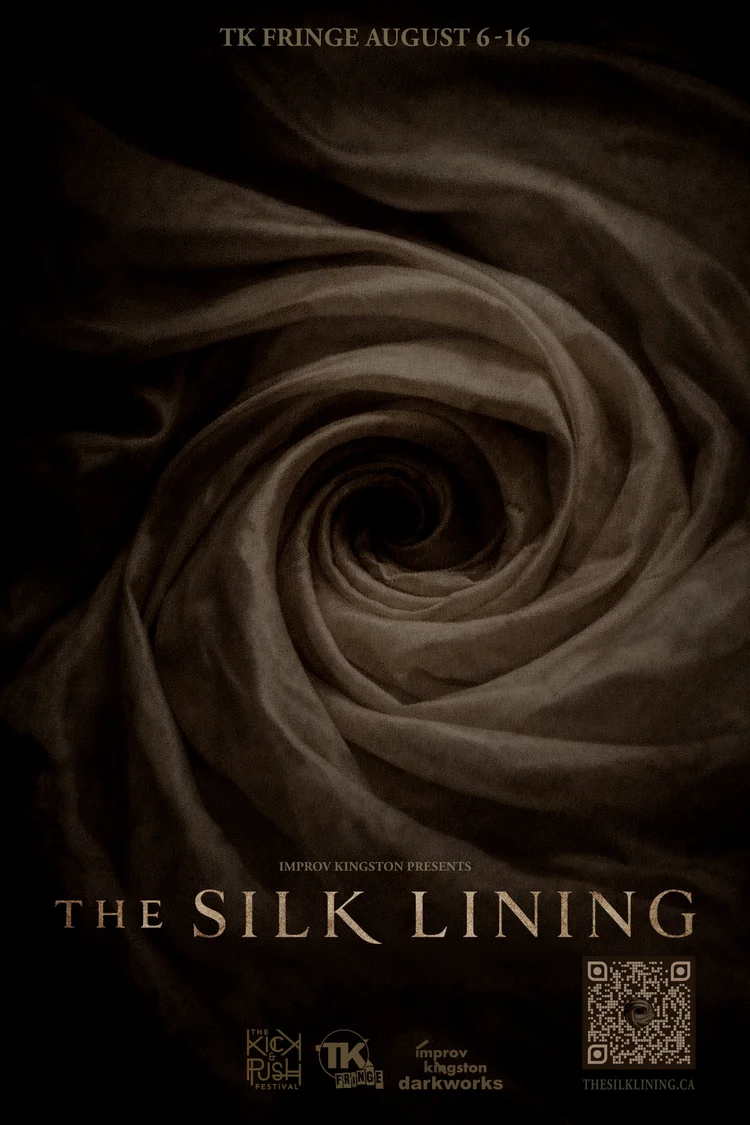
Say it with me now, don’t be scared… “Yog Sothoth!” I recently saw Theatre Kingston’s 2026 Fringe production of The Silk Lining, a one-man Lovecraftian horror play written and directed by Dan Walmsely. The show is staged as a “lecture” detailing the experiences of our leading man, Professor Isaac Vincent (Henry Korba-Babcock). He leads us on a journey into obsession incited by his coming into possession of an ancient artifact. A descent into the eldritch and untouched, The Silk Lining satisfies the age-old stirring for a dark, fantastical mystery.
With its quotable dialogue and an easy-to-follow magic system, Walmsely’s writing achieves a sense of history and a widened world beyond the walls of the Tett Centre rehearsal hall and the confines of the hour-long runtime. Professor Isaac traverses a neighbouring university, his brother’s place of exile, and hears whisperings of a conspiratorial cult: the worldbuilding is clearly charted for audiences to follow. Sporting its decisive mythmaking and setting construction, The Silk Lining wastes no time on superfluous concepts. Every new detail lays the groundwork for us to understand what is really happening instead of brooding on what could be—a desirable yet elusive effect often grasped at by fiction writers, but not often gripped as firmly as in Walmsely’s authorship.
The featured characters are smartly chosen and feasibly connected. There is a very manageable cast size in terms of actor sustainability and audience comprehension. Korba-Babcock is a hydraean thespian—a man of many faces, voices, and stature. He effortlessly and believably shifts from the jaded Professor Isaac to a composed female journalist, a seasoned cultist, and a Lovecraftian god.
The costuming, while not listed as a credit, elevates our Professor’s authenticity, presenting him to the audience as a polished scholar. A man of academia in any fictional-anthropologic setting must be tailored to the nines. A communicative tool reflective of his psychological state, the impact of his slow undoing rendered physical by the disheveling of his attire is tangible.
Will Smith-Blythe is the backstage hero of this production. There is a technical fluency in this show, a conversation between performer and environment that is receptive and responsive. The Silk Lining’s sound design is superb: the co-operation between live and prerecorded audio is seamless. Korba-Babcock harbours a command over his voice wonderfully in tune with the recordings and their use. This relationship is notable during a scene in which he sports a mask and mimes the physicality of his character while a pre-recorded vocal track plays as his own. Alongside being atmospherically lit, the moment is an exact example of the correspondence between technical and technique: briskly timed and terrifically acted.
Gorgeously designed, The Silk Lining is teeming with aesthetic touch; each set, prop, and costume piece at home in its created lighting environment. The immense power of the artefact is made perfectly believable by the collaboration of Henry Korba-Babcock’s recordings and Smith-Blythe’s spotlight.
This show has the cool factor: the effects land hard and rattle the audience. The Silk Lining tests the limits of a one-man show, revealing the potential of the medium. A captivating fresh take on an old-fashioned genre, this play is a must see.
‘The Silk Lining’ plays at the Tett Centre for Creativity and Learning until August 16, 2026. Find tickets and more information here.