Born or Created? ‘Blood Relations’ is a Powerful Staging of a Classic
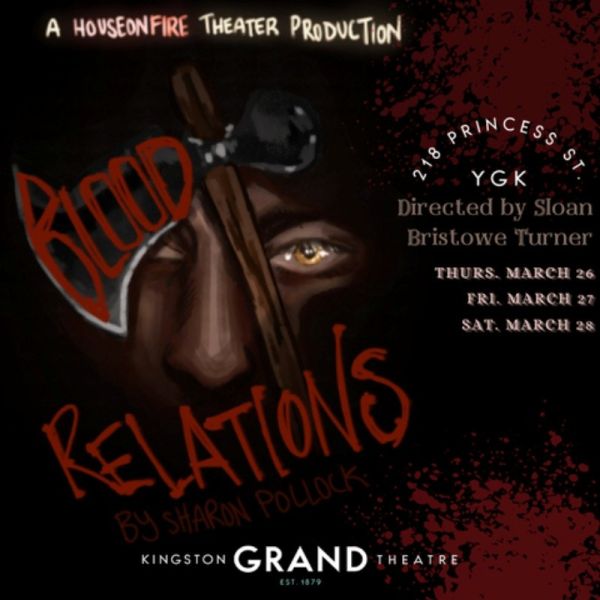
When walking into the lobby of the Baby Grand Theatre, one is rarely expecting to face philosophical questions about nature versus nurture. Yet, anyone attending opening night of House on Fire Theatre’s Blood Relations found themselves faced with that age-old question. Audiences were encouraged to mark on a line the degree to which they believe murderers are born, created, or some combination of the space in between—a perfect set up for the thriller awaiting them within the theatre.
Written by Canadian playwright Sharon Pollock, the play retells the infamous story of true crime legend Lizzie Borden (Ruth Drever Dwyer). The story begins with Drever Dwyer discussing her alleged crime with a friend, only known as the Actress (Sydney Black), who is desperate to know if Borden was the one to murder her father (Charlize Diaz) and stepmother (Annalise Lunn). Borden encourages her friend to walk through the moments leading up to the murders in her shoes, saying this will reveal if she did, in fact, commit the crime. For most of the play, Black portrays Borden, while Drever Dwyer plays the family’s maid, Bridget, but the two occasionally shift back to their true selves when discussing the events of the past.
Directed by Sloan Bristowe Turner, the production makes excellent use of the Baby Grand’s space, splitting the audience into two banks while still giving viewers clear sight lines of the happenings onstage. Kailee Owen’s lighting and sound design immerses audiences into the world of Lizzie’s memory, using ambient noise and echoing interrogation lines from The Defence (Ryan Larkin) to create an unsettling atmosphere. Owen’s lighting design is simple, but features Edison bulbs hanging over the main stage space which flicker intermittently and give the set a more late-1800s feel. However, in moments of heightened emotion, there is a shift to vibrant, pulsing green lights which provide eerie backlighting to the more intense moments. The stark contrast of the interrogation light is well done, however some of the blocking surrounding it seemed a bit uncertain at times, with actors shuffling into place rather than already being set to stand in the light.
Azriel Joyce’s costumes are simple, but convincingly of the period; there is an especially fast quick change, completed by Gaia Adjemian, who transforms from Harry (in pants and a matching vest) to Emma (in a skirt and new vest) in an incredibly short time, appearing on the opposite side of the stage from where she last exited. To distinguish when Drever Dwyer was performing as Lizzie or Bridget, her costume cleverly switched from shawl to apron. There were a few moments, however, when it was unclear which character she was, as these switches were somewhat inconsistent.
This division of roles is a major feature of Blood Relations due to the frame narrative that encases most of the story, with the Actress, who portrays Lizzie Borden for most of the show, and Lizzie, who appears at certain key moments, being played by two separate people. Black and Drever Dwyer are frequently onstage, even when they have no lines, observing the happenings of the past, watching from behind, and casting judgement as scenes continue without their respective characters.
Black is excellent as the Actress, creating a strong divide between the actor who begins the play, morphing her mannerisms, tone of voice, and physicality as she captures Borden’s emotional state. Although she had a few stumbles on lines throughout—likely from opening night nerves—Black depicts the complicated center-piece of the story well, and the sincerity she displays in Borden’s darkest moments shape the character into one that audiences could begin to root for—an essential factor in this story. Drever Dwyer had similar line stumbles, but does a good job of capturing Lizzie’s unsettling nature, albeit in a more scattered, unhinged way compared to Black’s often calm Lizzie, who only occasionally bursts into fits of powerful emotion. The pair portray the protagonist in slightly different ways, which was perhaps a directorial choice to mark the contrast between the real and reimagined Lizzie Borden, but sometimes made for confusion when comparing the characters to one another.
Diaz and Lunn display excellent authority as Mr and Ms Borden, respectively, with Diaz having various emotionally jarring scenes which are done with ease, and sharing lovely chemistry with Black in their more tender moments. Lunn is prim and distant as Borden’s stepmother, with lovely physicality as she depicts a woman who views herself above her peers: I particularly enjoyed a scene near the end of the show—a clever use of the Baby Grand’s space—as Lunn’s character is scripted to go upstairs, which is creatively done despite the set’s constraints.
To round out the cast, Adjemian balances the opposing Emma Borden and Harry well, changing her performance to reflect Emma’s proper nature or Harry’s boy-ish charm, helping to differentiate the pair. Ryan Larkin brings a lovely kindness to Dr. Patrick, while still maintaining the character of someone of a higher standing, sharing charming moments with Black and emphasizing her descent into upset. I really enjoyed the staging of Lizzie’s court scenes, with Larkin ominously standing on an elevated set piece and lit from above, obscuring his face: it paints a stunning scene picture as the characters are suddenly enveloped in darkness, back on trial for the crime.
Overall, Blood Relations is a stunning production. Despite a few minor stumbles, the performances are strong, the vision for the production is clear, and the many inventive solutions to complex staging make for a show that understands how to best make use of its given space. Perhaps more importantly, it leaves audiences to rethink the decision they made before entering the theatre: are murderers born, or are they created?
‘Blood Relations’ is presented by House on Fire Theatre, and played at the Baby Grand Theatre until March 28th, 2026. More information can be found here.