The Theofest Sixteen
How can one article accurately capture the inner-workings of 16 individual, student-written shows?
This is a thought that routinely popped into my head as I prepared to tackle writing about Theofest 2026 this past week. The festival takes place entirely within various spaces in Theological Hall—the home of Queen’s Drama and the reason behind the festival’s name. Students of DRAM439: Advanced Performance Creation will be spread out across various rooms and floors of the building, from the Rotunda Theatre all the way to any spare corner that has the potential to be transformed into a performance space.
Walking into the class on an early spring morning in late March, I am immediately greeted with a burst of energy. Nearing the start time, the students enter one by one and find seats close together, chatting with each other and Dr. Mariah Horner—the course professor this year, who more commonly goes by “Mo”—about any number of things, lively and bursting with more energy than anticipated so early in the morning. As everyone settles in, closely knit and towards the front of the room, Horner tells them about the change in class format for the day, with them starting rehearsals right as class begins, and regrouping later: everyone launches into different directions.
I begin my journey by staying in room 102 alongside Fiona Kolbuc-James and Tara Martin, as this is the performance space for their shows. Each student is somewhat partnered up with one or two others, usually with the peer who is performing in the same area so they are able to provide feedback on each other’s projects throughout the entire process. As the pair in this room huddle together discussing their plans, Kolbuc-James mentions they hope to create a movie trailer for their show, Waiting for Fish, in class. Martin explains she would like to get to work on memorizing her script, but also wants to showcase the piano piece she has included in her show, Get Your Just Desserts. As Kolbuc-James gives some advice on Martin’s script, with both working out some ideas, Ava Preston, creator of I’m Sorry, Professor and the third student to share the room, hurries inside. The three chat for a bit, before Preston explains that she will spend most of their time to herself, in order to finish her script, but welcomes any ideas they want to bounce off of her.
Leaving this trio to their devices, I wander towards room 118 following Annalise Lunn, who glides ahead of me in a beautiful 19th century style skirt. Finding my way inside the small room, Lunn plops herself onto a small couch, script of her show, Somebody, Not Sepia, in hand, and quietly mutters her lines under her breath, memorizing and moving through her blocking: this is her first rehearsal in the skirt, and she is ensuring her movements are doable in the hoopskirt. Elliot Norman shows me the posters that serve as props for his post-apocalyptic show, As Long As You’re Laughing, which include warnings such as “Just say no to cannibalism,” and “Are you radioactive? Get checked,” among others. This room is quieter than the first, with the pair working separately, but touching base that later on, Lunn will help Norman run lines for his show, in which Lunn has a small part.
Beyond 118 lies the Rotunda Theatre, often the home of DAN Major Productions: here I find Eshan Kumar and Will Mercer, flipping through different lighting options in the dark theatre. Mercer stands in the stage space, while Kumar is at a nearby table programming the lights for Mercer’s Disguise, toying with subtle strobe effects and colour changes while Mercer walks the lights within his blocking. Before heading out, I chat with Kumar about his show, also in the Rotunda, called Make a Deal, asking why he chose this space for his performance: “The Rotunda is where I worked on the first Major I enjoyed, so there’s a lot of significance for me here.” As this will be one of the last things he does for his undergraduate degree, he wanted to return to the space where it all began.
Walking through one of the basement exits of the Rotunda, I wander past room 011, where Megan McDonell’s installation, Dear Theological Hall, is set to go up, and find her and Linden Imeson Jorna in the green room. Both are working quietly on their laptops as I walk in, and I take a seat near McDonell to see what she’s working on. She tells me about her installation, which is the only part of Theofest that has no set performance time, allowing audiences to freely come and go. McDonell’s in the process of continually reaching out to alumni of the DAN School, collecting stories and old show posters for her installation—a piece inspired by the history of the building and its inhabitants. It will cover all of 011, but will also have sections scattered throughout the building for audiences to see across other show locations.
Imeson Jorna and I discuss his plans next: he is trying to piece together a more solid outline of his mostly improvised show, It Ends With a Hug, which takes place in an end-times bunker. Jorna’s character within the bunker is none other than a clown, offering advice for those who are distressed with the state of the world. He’s hoping to clarify his message about the morals we can find in the end of the world, especially during these “trying times.”
McDonell and Imeson Jorna direct me to the dressing room where Ashley Miller is rehearsing. She explains that her show, All The World’s A Stage, is a collage of various Shakespearean lines out of context as an actress prepares to perform in a production of A Midsummer Night’s Dream. Miller performs part of it for me, working lines in the mirror as the glow of the dressing room lights illuminates the space, using me as a stand-in for the participatory elements of her show.
I wander upstairs to the Chapel to see Devon Mahoney and Nic Lindegger, but as I wander in, Mahoney is nowhere to be found: instead I chat with Lindegger, who talks me through the soundscape present in their show, The Claws of Devotion & The Soul Left Behind. They explain that they aren’t rehearsing today because they did not bring the wedding dress which they perform in. Instead, they tell me about the lack of spoken dialogue in the show itself, and play a rendition of a theme from La La Land for me on the organ before I go.
As I walk across the second floor, to Convocation Hall, I find Mahoney! She is in the final minutes of a run through of her show, Dog Face, with Olivia Buchanan and Fiona Morin, the creatives who share Convocation Hall, watching her from chairs that have been fashioned into a makeshift audience bank on the stage. I sit in one of the chairs in the lecture hall, so as to not interrupt, and as she completes the run, Buchanan and Morin clap and cheer, hyping her up and complimenting Mahoney’s newly finished script. Joining them on the stage, I talk with Morin about her rehearsal process for her show The Eldest Daughter Syndrome today, where she mentions she had run through half the show before I had arrived. Buchanan, creator of The Wrighters Room, mentions that she has yet to finish her final script, calling these last couple weeks before opening “the grittiest part of the process.” The trio laughingly describe how “play time’s over… it’s time to lock in,” regarding these final few classes before they head into tech week.
Heading up the stairs into the final spots of the festival, I find Bas O’Brien in the hallway space outside of the entrance to the balcony of Convocation Hall, practicing the end of his Clown Show, a calmer deviation from the atmosphere in other rooms. He tells me about his the performance, which is a variety act set in this liminal space; as he tells me about the show, he practices creating balloon dogs, a trick he will perform during the show itself. Nearing the end of our conversation, I overhear Buchanan, from Convocation Hall, practicing a composition for her show on the piano.
Finally, but certainly not least, I wander into Horner’s office. Cassian Manderson is setting up an elaborate marble track, mounted on the wall, for his show, Among the Stars, a comedy that centers around the idea of the Canadian government sending a competing animal to space after Russia sent up Laika in 1957. Manderson describes that he was looking for a way to make interesting props, as it has become a major point of interest to him in his time at the DAN School, and this show is the vehicle to do so. He tells me the marble track is a rocket for the animal, and the marbles are energy, just before we glance at the clock and realize the hour has flown by; it is time to return to class, peers excitedly spilling from every doorway in the building as they make their way back to their shared space.
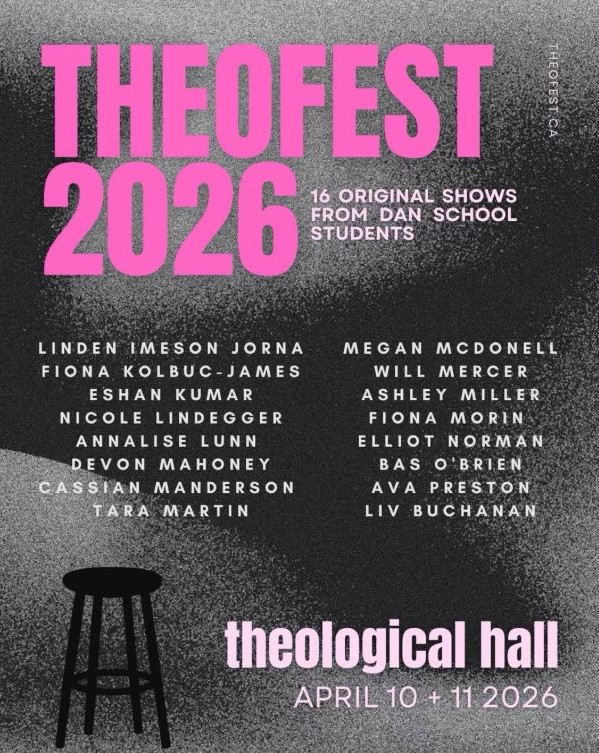
In short, there is truly something for everyone at this year’s Theofest—16 free original performances, from students who are able to use this course as a jumping off point for creating original work. While Theofest may be the debuts for these works, I hope and know it won’t be the last we see of them.
Theofest is a free festival of 16 original solo performances created by upper-year students in the DAN School of Drama & Music at Queen’s University. Theofest runs from April 10-11, and you can find out more here.