‘Animal Farm’: An Astonishing Adaptation of a Classic
“All animals are equal, but some animals are more equal than others.” – George Orwell
One of the first classic novels I read in grade school, Orwell’s Animal Farm is one that stuck with me well beyond my eighth grade classroom. An allegory for the Russian Revolution and Stalin’s rise to power and subsequent dictatorship, the novel also carries a wider warning of the ways in which governance can be manipulated for the personal gain of those at the top—a lesson that remains increasingly relevant in our present political sphere.
So when it was revealed that a new adaptation of the book, written and directed by Dr. Craig Walker, was being brought to the DAN School of Drama and Music for this year’s Winter Major, I was beyond intrigued to see the final product. I was not disappointed.
Entering the Rotunda Theatre, audiences find the space (set design by Heiden Jacobi) has been transformed into a barn. Making use of the balcony above the stage, the set is built high into the theatre, featuring an upper barn area accessible to the actors via ladders. These hayloft-like spaces not only provide play space for the actors, but also transform the lower levels of the barn into a place for actors to sit in stable-like areas, watching the action even while their character is not involved in the scene. The space itself remains well lit despite the levels in the set, with lighting designer Hunter Wolfe using light bulbs hanging from the ceilings of the set in addition to traditional stage lights to create dimension, making use of the set’s shadows to help the performers shine.
Another integral part of the set is the central barn doors, which open to reveal a sheet for shadow puppetry (designed by Cassian Manderson), which continually function as an effective manner of portraying scenes, such as the building of the windmill and Snowball’s expulsion from the farm, which are difficult to convey on stage. Although there were a few bumps with the puppetry early on during opening, it was one of my favourite aspects of the show, and was very well incorporated into the overarching design.
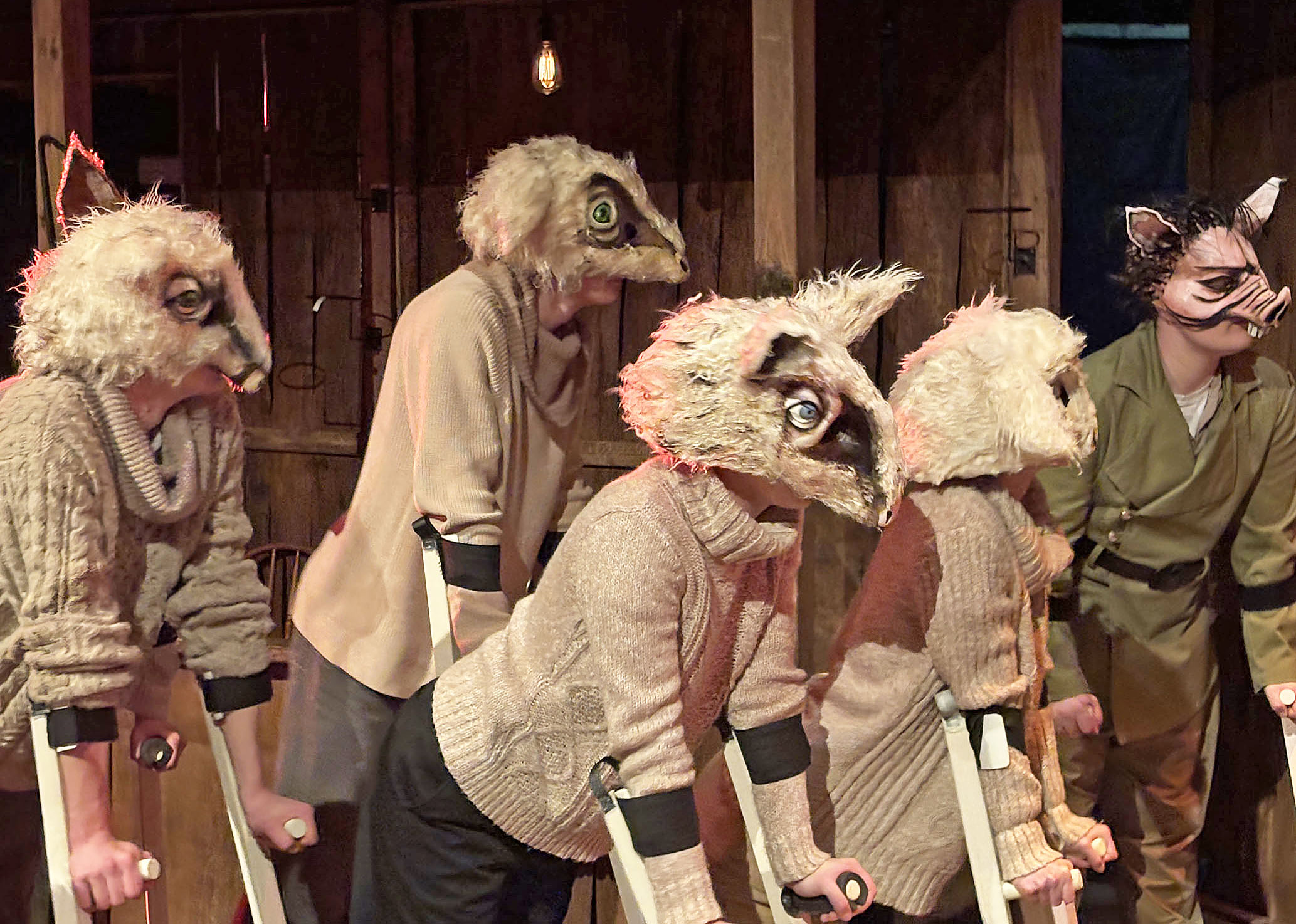
A central feature of the production are the intricate masks (designed by Clelia Scala, with bird masks designed by Katie Duncan), which the performers wear for the majority of the production, only raising them to speak lines of narration throughout the show as part of the chorus. The masks are large and elaborate, with each completed by students under the supervision of Scala, and when paired with the naturally textured, farmhand-inspired costumes (designed by Duncan) and stilts which resemble hooves, the audience is immersed into the world of the farm. Each actor’s performance is amplified by these designs, as the cast roams across the stage, moving and reacting as their respective animals would throughout the story.
The pacing of the show is quick off the top, even catching those of us who are familiar with the classic novel by surprise. That said, the swift patter of lines from the beginning is effective in catching the audience’s attention, especially with so many characters to introduce.
The performances are strong, with each member of the cast featured in some way throughout the play. Sloane Climie captivates audiences from the beginning of the show as Old Major, with a lengthy monologue to inspire the animals to revolt. Jago Garrett’s low, gravelly voice and demanding stage presence makes for an intimidating and commanding Napoleon, manipulating the laws of Animal Farm and ruthlessly turning his back on the others more and more as the story progresses. His performance is complimented by Ricky Yankowich’s Snowball in Act One, bringing immense physicality and conviction to Napoleon’s rival and expertly livening the features of the character.
Audiences are treated to a charming trio of performances in Muriel (Renee Foley), Clover (Sophie Wilson), and Benjamin (Kai Ileleji,) some of the oldest animals on the farm. The former two convey the maternal, yet powerful influence they have with ease, and Ileleji embodies the age and exhaustion of Benjamin throughout the show, looming with dismay as things continually turn for the worst. Kate Popiel’s Mollie is ditzy and sweet, and the combination of her mask—adorned with bright bows—and physicality bring lovely comedic relief into the first act. Each of the principal performers have wonderful chemistry with one another, as well as the supporting animals they interact with; Wilson’s moments with Hayden Crompton’s Boxer in particular make his untimely and heartbreaking departure from the farm that much more devastating, as audiences watch him slowly deteriorate under the pressure of working on the continually rebuilt windmill.
Animal Farm is a stunning adaptation of a classic, proving to audiences that despite being published over eighty years ago, it is relevant now more than ever. Not only are audiences able to witness the hard work of a talented group of student creatives, but they are also reminded of how easily revolutions can be twisted into something much more sinister.
‘Animal Farm’ is presented by the DAN School of Drama and Music, and will be playing at the Rotunda Theatre until March 15th, 2026. Tickets and more information can be found here.