Both Renewed and Recognizable: Domino’s ‘A Comedy of Errors’
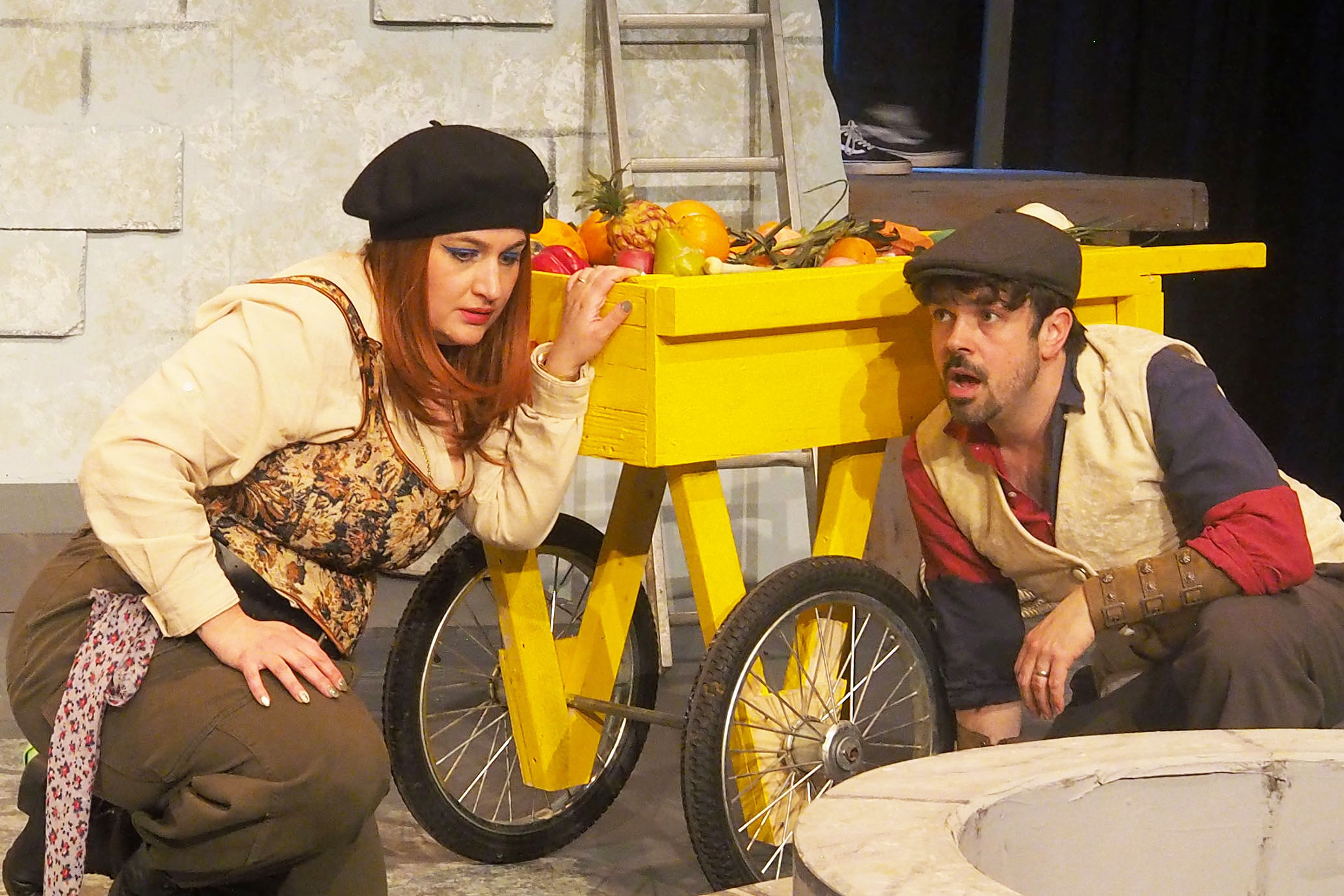
Stepping into the Domino Theatre on April 23rd, 2026, one had to be prepared for two theatrical occasions: Opening Night of A Comedy of Errors, and the 462nd birthday of William Shakespeare. As an English Literature student with a passion for live theatre, I am always eager to see how accessible a new adaptation of the Bard’s work is for modern audiences. I could not be more thrilled to see A Comedy of Errors come to life with director Emily A. Pickett’s take on the show.
Pickett has a strong vision that is clearly closely aligned to her cares beyond the Domino itself: she is a PhD candidate in the Department of English Literature and Creative Writing at Queen’s, with a research focus on “genderbent all-women productions of Shakespeare’s plays.” The genderbending of numerous characters across the play—most importantly, of the Antipholous twins into the Phyllis twins—is the guiding point for the entire production. This reframes the play and brings an entirely different spirit to the text itself. Furthermore, Pickett’s setting of the happenings in the fictional, post-apocalyptic “Queenston,” rather than the original placement in the ancient Greek city of Ephesus, brings the audience familiarity and closeness to the plot, adding to the heightened comedy within the story.
When walking into the theatre space, any Kingstonian will immediately recognize the setting (set design by David L. Smith): a deteriorated version of City Hall and Springer Market Square, complete with various market stands that actors interact with throughout the show, throwing vegetables from the fruit stand (designed by Michelle Freedman), and changing into clothes that hang from racks on another part of the stage. One of my favourite features was the familiarity both in seeing this setting onstage, but also hearing it reflected in subtle changes made to the script; in shifting where the story takes place, Pickett makes adjustments to the locations referenced in the play, resulting in raucous audience laughter each time a new Ontarian location is mentioned.
From the beginning of the performance—opening with an added scene prior to the first moments of Shakespeare’s script—actors flood into the theatre from every possible entrance, assigning parts in the play and announcing the changes they will make to better suit the story to where and who they are. Audiences also see these changes reflected in the costumes, designed by Anne-Marie Kooiman: dressed in a mixture of typical Shakespearean blouses and vests, but also with modern additions. I particularly enjoyed the costumes of the Courtesan (Rhapsody Blue), the First and Second Merchants (June Shepherd and Eli Whenham) and the Jailer/Officer (Serena Melody James), the latter who donned a bright red “Fort Henry Guard” sweater, but paired with knee high boots and fishnets, another hilarious nod to the city’s history.
Shannon Donnelly and Jen Buder are hilarious copies of one another as Phyllis of Queenston and Phyllis of London respectively, in matching wigs and costumes that cement them as indistinguishable to the people of Queenston; the same can be said for their servant counterparts, Dromio of Queenston (Michael Donnelly) and Dromio of London (Apollo Magus), who share an enormous similarity on stage through their costumes combined with their strikingly similar hairstyles. I could not mention costumes, hair, and makeup without acknowledging Mother Solinus (Ian Burns), dressed to the nines and done up in full drag, with the staple sharp contour, bold eye look, and an impeccably-styled wig to match. This marked a shift in the strict character of Solinus, for the better—I adored every moment they were onstage, bringing a new layer of presence and command to the role, and the nod to Burns’ own drag persona, Rowena Whey.
Each production element collaborates seamlessly with one another throughout the show, from the aforementioned costumes, props, and set, to the simple, but effective lighting design by Will Britton. Moreover, there is never an uncomfortably quiet moment (unless it is necessary for a laugh) onstage, thanks to Aahana Uppal’s sound design, which features a range of stringed music smoothing over the scene transitions, and effects that emphasize the humour of the comedic happenings onstage.
As a theatregoer, it can be intimidating to venture into watching one of Shakespeare’s works live; it is all too easy for actors to not fully understand what they are saying, thus making it difficult for audiences to know what is going on. That said, the entire cast of A Comedy of Errors is successful in translating the story as a whole to viewers, as I encountered only a few moments where I was uncertain what the characters were discussing, a testament to the company’s dedication and skill. This is a work that is very accessible compared to some of Shakespeare’s others, and the care with the script accompanied by the heightened physical comedy made the events clear, even to audiences who may feel less familiar with the language used.
A Comedy of Errors is a key example of what happens when all elements of production fully come together to support a distinct directorial vision, and succeed. The collaboration from the entire team is especially clear with this final product, bringing the Bard’s comedy fully into the audience’s everyday life in the best way possible.
‘A Comedy of Errors’ is presented by Domino Theatre and plays at the Domino Theatre from April 23rd to May 9th, 2026. More information can be found here.