‘Women of the Fur Trade’ is a Must-See Satire with Bite
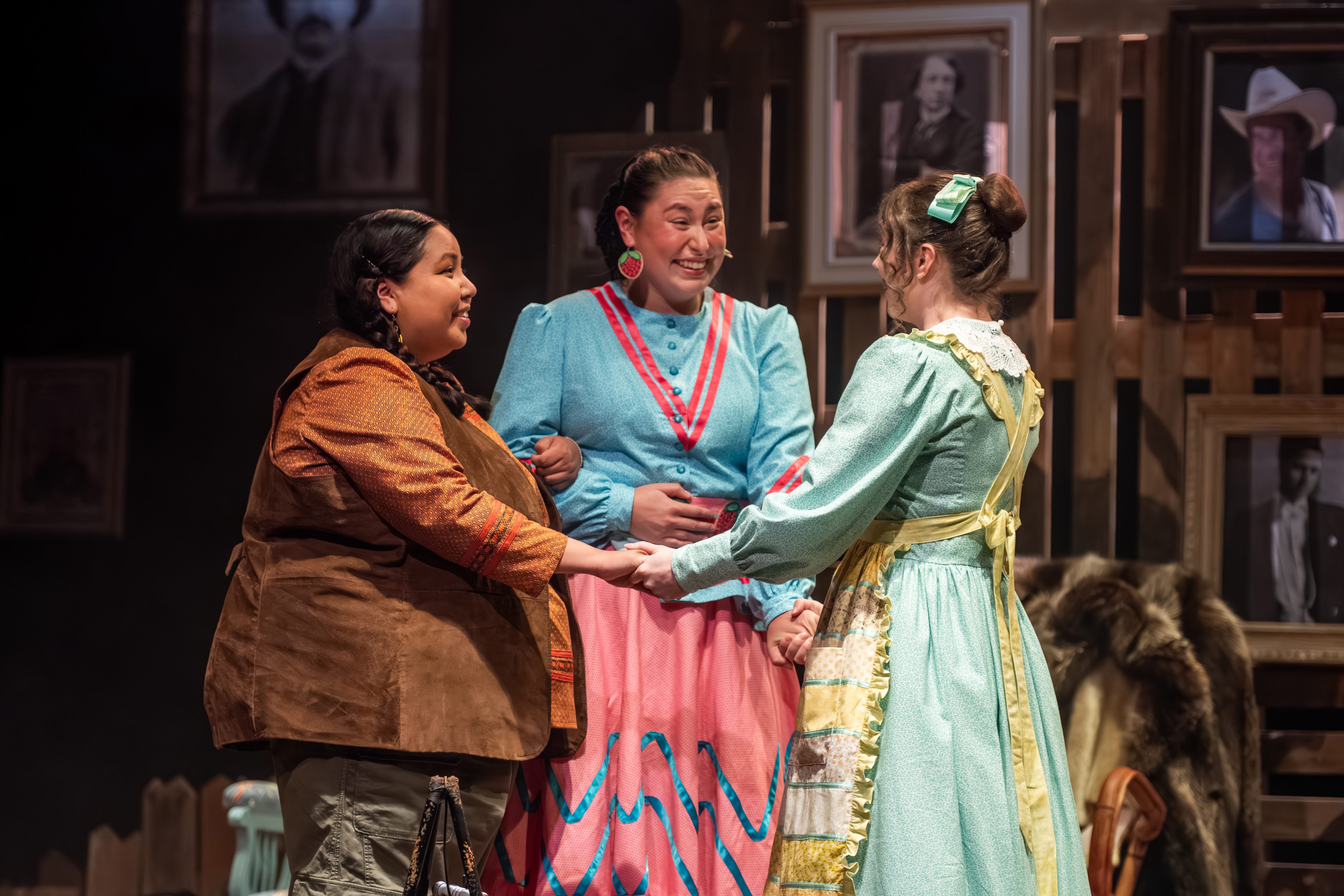
With Women of the Fur Trade, Thousand Islands Playhouse opens its 2026 season with a fine-tuned balance of biting satire and roaring comedy. Directed by Keith Barker alongside Apprentice Director Stephanie Fung and written by Frances Koncan, the play focuses on three women who sit trapped together in a frontier fort: Marie-Angelique (Danelle Charette), a Métis idealist who fangirls over Louis Riel; Cecilia (Alison Beckwith), a British settler concerned for her husband; and Eugenia (Joelle Peters), a level-headed Ojibwe trapper. Together the women rock in their chairs, pretend to drink tea, and explore what it means to be trapped in the roles carved out for them by male-dominated history through dialogue laced with tongue-in-cheek jokes.
Joining the women of the fur trade on stage—and, notably, outside the walls of the fort—are Louis Riel (Elliot Gosh), the Métis leader, and Thomas Scott (Eli Ham), Riel’s sensitive companion who adds a Cyrano de Bergerac aspect to the story. The men’s banter and bickering is often comedic, and Gosh’s frat-boy-adjacent portrayal of a historical Canadian figure is somehow both over-exaggerated and believable.
All five actors clearly know the script backwards and forwards, leaving barely any room to breathe between the end of one line and the start of the next. With tight cues and excellently covered errors (of which there were nearly none, even during the preview), the actors were each able to shine in their own right. In their roles as white settlers, Beckwith and Ham have the trickiest roles to play, as their dated (though era-typical) views make them easy to immediately dislike, but both actors navigate the complexity of their roles deftly.
Peters has the fewest lines, but her calm and straightforward demeanour places careful emphasis on her words each time she speaks. Charette brings the unrelenting energy and positivity of a kindergarten teacher to the character of Marie-Angelique. It is inspiring, yet also highlights how exhausting it can be to hold onto idealism. As a Métis woman, Marie-Angelique is caught between two cultures, so she is likewise positioned between the two women who represent those cultures, often unable to appease one without spurning the other. This clear staging choice is one of many directorial decisions that communicate the show’s themes effectively, even to those who might not have an eye for close analysis.
Upon entering the Firehall Theatre, guests will immediately be struck by the set designed by Jay Havens. A short wooden fence surrounds the fort where the three women sit in their rocking chairs, and behind them stands a wooden wall of curious (but perhaps not unrecognizable) shape. Adorning this wall, as well as the walls of the theatre itself, are framed portraits of all sorts of men—famous and infamous, alive and dead, beloved and despised—that look down at the players.
While much of the set functions as a cage for the three women, Havens’ playful and creative design lays a foundation upon which the show can be both fun and pointed, allowing the actors space to be larger than life while still preventing the audience from forgetting that this is a story about traps. Trapping animals for fur, trapping Cecilia in marriage, trapping the women of the fur trade in a fort from which they cannot leave because there is no door.
Though it is brimming with thoughtful commentary, Women of the Fur Trade is at its most genuine when it is pretending not to be. The script bounces between clever and thoughtful dialogue to movie quotes and lines from pop culture, effortlessly intertwining the struggles of the past with the problems of today. The play’s message comes through clearest when the show leans furthest into the comedy—and it sure does lean into the comedy.
Right from the beginning, when Kahentanó:ron Brianna Montour’s lighting and Lucas Ruddell’s sound design work in tandem to help the women introduce themselves like overdramatic stars of a reality TV show, audiences know this play won’t take itself too seriously. Playful chimes ring out when letters arrive, and bird calls signal when fowl letter-carriers swoop in on poles held by stage hands—my personal favourite being a decoy duck, wings tucked securely at its sides, floating six feet above the floor.
The show falters only slightly towards the end. After one of the plotlines wraps up, the characters are left on stage without a clear goal. This leaves the audience unsure where the story’s finish line will be, making it easy for the pace to begin to drag. This change in pace is emphasized in the shift from group dialogue to more side-by-side-by-side monologues, interrupting the smooth flow found in the rest of the play with heavy-handed statements of the show’s main themes—an unnecessary clarification for any audience member who was paying attention.
Despite the minor pacing issue, the play is a must-see. Before heading into the show, I suggest loosely brushing up on your Louis Riel knowledge—otherwise, the only thing you need to prepare for is having more fun in nineteenth-ish century Manitoba than you could expect. Go for the stunning fur coats (costume design Asa Benally), stay for the absolute hilarity of Cecilia pretending to pour cups of tea, and prepare yourself for both striking commentary on the timeless necessity of activism and every great duel in cinematic history rolled up into one, but with sticks.
‘Women of the Fur Trade’ is playing at the Thousand Islands Playhouse’s Firehall Theatre from May 1 to May 24, 2026. Click here for tickets and more information.