A Wordless Wonder: ‘Le Concierge (The Caretaker)’
The Caretaker walks through the empty halls of a high school, paying no mind to the 20 people following him. He occasionally pauses to drink from the fountain, or to tune his radio to the right station. All the while, myself and 19 others fan out around him, taking in the different angles of this Caretaker’s nightly routine of monotonous and essential work.
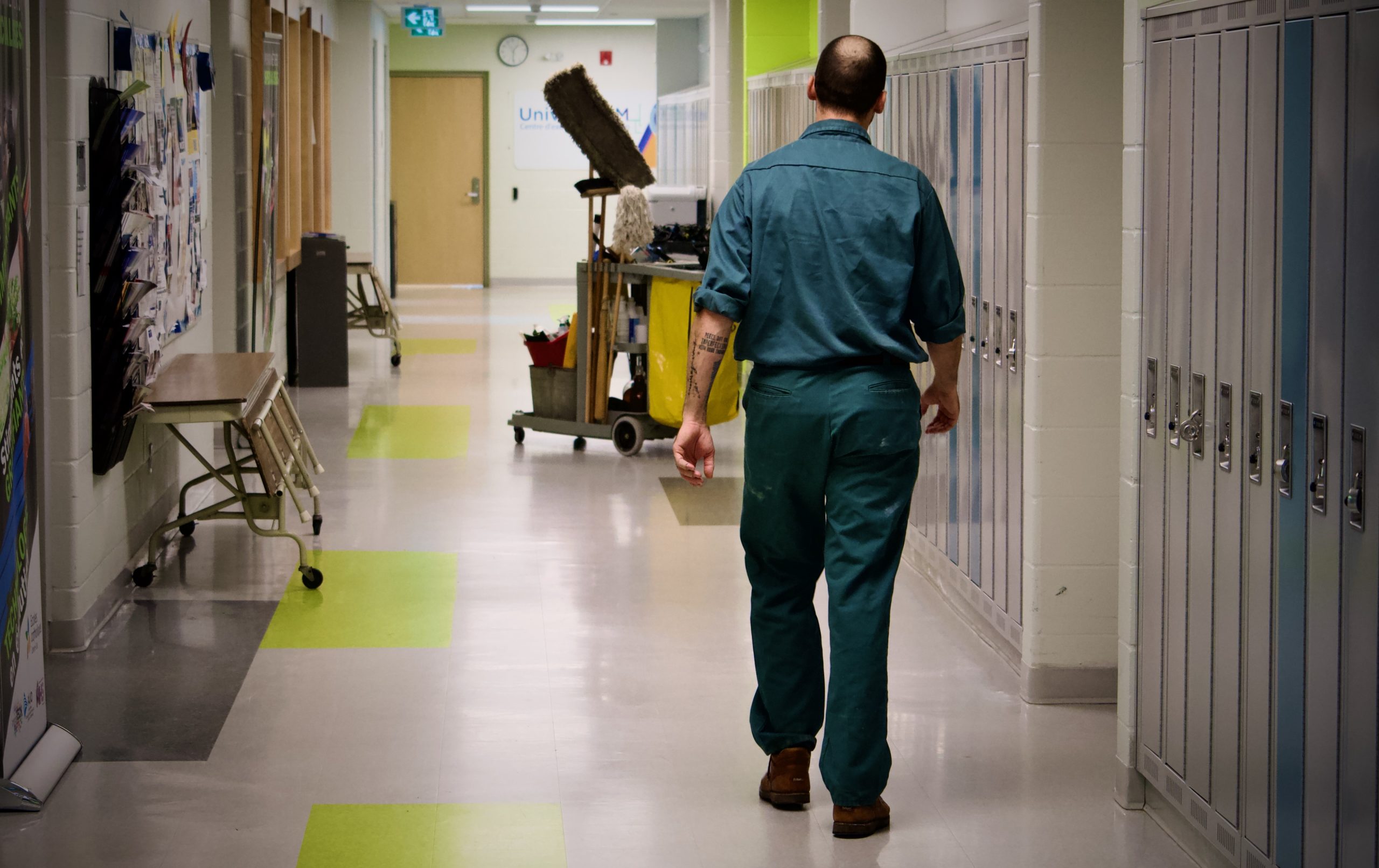
Le Concierge (The Caretaker) opened on Thursday night at the Centre culturel Frontenac (CCF), based in the high school building shared by École secondaire publique Mille−Îles and École secondaire catholique Sainte-Marie-Rivier. The show, directed by Daniele Bartolini, marks the beginning of the 2026 Kick & Push (K&P), and if the Festival’s upcoming shows are as captivating as this one, Kingston audiences are in for a treat.
Arriving at the high school, I am not entirely sure what to expect. Despite having spent the past decade in and around the theatre sector, I have never actually been to an immersive performance. I am nervous, but open minded. There are a maximum of 20 audience members permitted in attendance, and we are each given a highlighter-green high-visibility vest to wear. It clashes with my outfit, but it seems to have the same effect on everyone, so I don it without complaint. The 20 of us wait in a small room, listening to an elevator-music-jazz song on repeat, until the metaphorical curtain rises.
We are ushered through a door and into the backstage corridor of the high school’s auditorium, then onto the stage, where 20 stools are lined up for us. It is here that stage manager Christoph Ibrahim delivers—in English and French—the preshow speech preparing the audience for what to expect, how to behave, and most importantly, establishing their role as director. Ibrahim tells us that throughout the show, we should imagine ourselves to be a cinematographer on a movie set; our eyes are the camera, and we are filming one long, continuous take. It seems silly in the moment, but that small piece of advice fundamentally shapes my experience of the show.
The titular Caretaker is played by Vincent Leblanc-Beaudoin, who also co-created the show. With no spoken dialogue, he demonstrates just how much can be conveyed without words. Not just through facial expressions, but also through movements or the lack thereof; in the small, careful pauses between actions, in the items he stops to regard, or the windows he chooses to look through.
For the most part, Leblanc-Beaudoin is completely alone, but it never feels like it. In an interview with CCF’s Tracey Guptill, Bartolini states that in a way, the space itself acts as the scene partner for Leblanc-Beaudoin. The physical space has been elevated to the role of actor, helped in part by the set and costume design of Melanie McNeill. Throughout the path walked by the Caretaker, furniture is laid out with careful intention, indicating clearly the places the audience is encouraged to venture into, discouraged from entering, or welcome to sit upon.
In moments where reality almost melts away, Sarah Mansikka’s lighting design and Andrea Gozzi’s sound design harmonize to keep the audience grounded in place despite steadily slipping into the surreal. Almost more impressive than the technical effects are those that are naturally occuring; the sun setting on the horizon, the sound bouncing off the hallway lockers, the children outside screaming joyously as if on cue. But these atmospheric effects only ever heighten the story, never pulling our attention away from this hour in the life of the Caretaker.
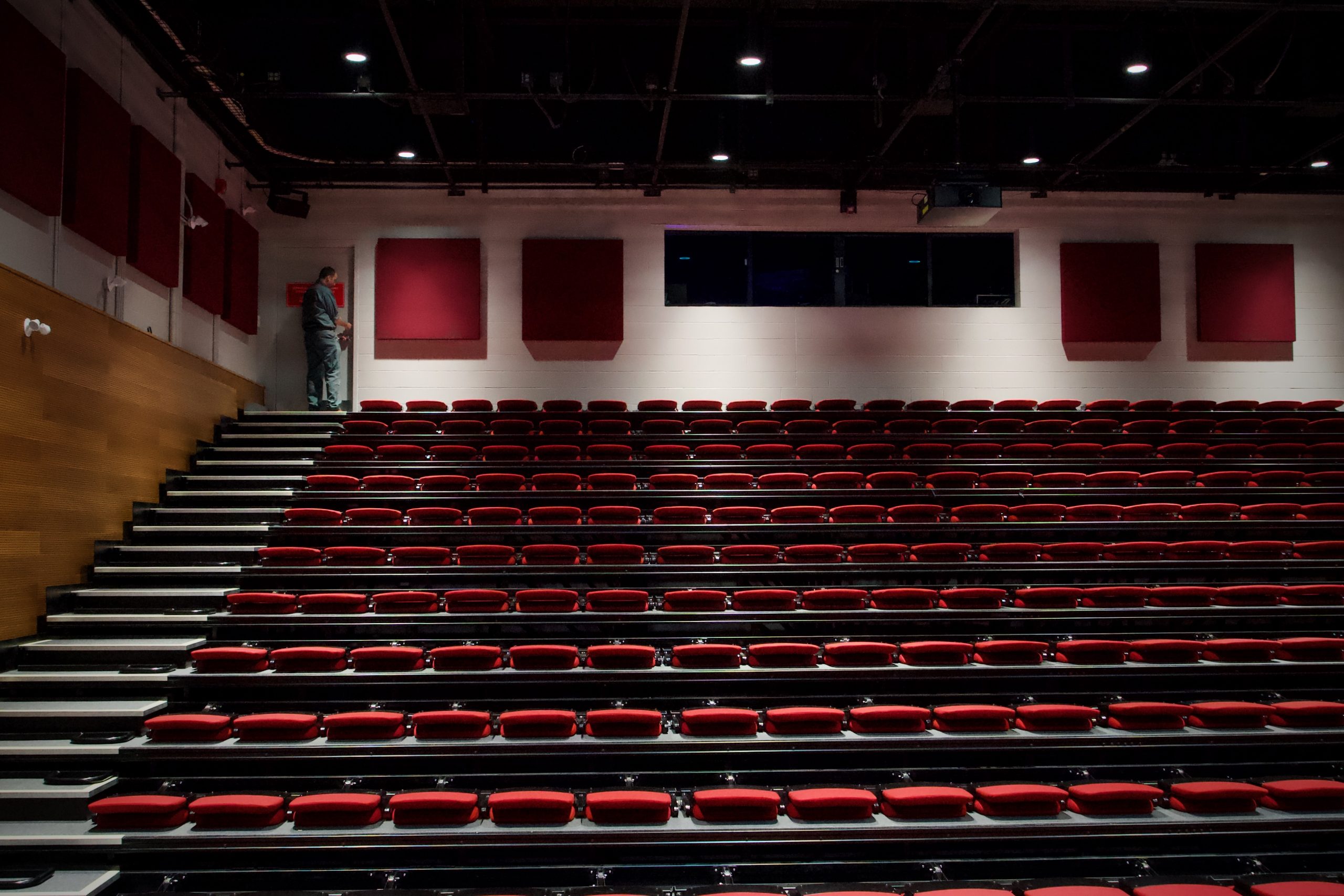
Throughout the show, as we venture up stairwells and down hallways, I am grateful for Ibrahim’s initial advice to imagine my eyes as a camera. Suddenly my glances away from the Caretaker are no longer a distracted gaze wandering towards the window or the books in the library—in the context of cinematography, they are shot-reverse-shots which add to the narrative.
Ibrahim’s single direction given before the show gives the audience freedom to create their own interpretation by means of literal framing. If you choose to look primarily at the Caretaker’s work—the drywall dust on his coveralls or the grip of his hands on the broom handle—the story might be one of blue collar work, about how all labour is meaningful. Perhaps, if your gaze pulls back far enough, your view encompasses the audience as well—highly visible in neon-green as they stare at the working man—and then the story becomes one of spectatorship and class dynamics. Or maybe if your ‘camera’ lingers on the piano keys, the self portrait, or the ponderous look given to the painting on the board, the piece asks us instead to examine the power of and criteria for art.
At Thursday night’s performance, there were 20 different interpretations of the show, each singular in their perspective and based on an individual experience that cannot be replicated. If you are lucky enough to see Le Concierge, your eyes will film a story no one but you will ever see.
Personally, the opening shot of my film was clearly influenced by Edward Burtynsky’s photography, and the closing shot was its mirror. Did this create a circular structure for the narrative, or was this cyclical theme embedded in the story to begin with? After all, there will always be more dirt to sweep off the floor, just as there will always be more sunsets to see and pianos to play.
‘Le Concierge (The Caretaker)’ runs from July 23 to 28 as part of the Kick & Push Festival. For more information and to purchase tickets, click here.