A Man, Not a Myth: Theatre Kingston’s ‘JOSIAH’
Content Warning: ‘JOSIAH’ deals with topics like slavery, racism, and trauma. Although this review does not discuss these topics in depth, they are general themes in the performance.
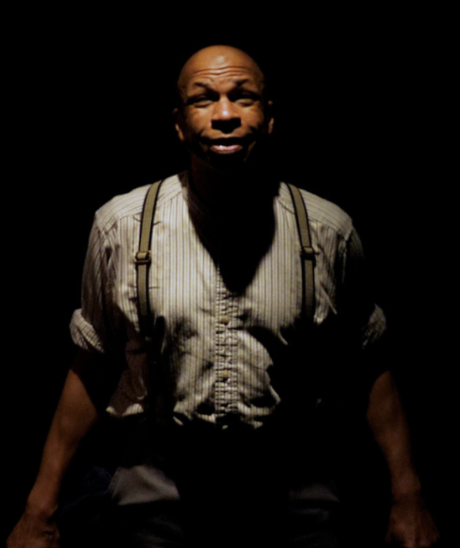
I had the chance to catch Theatre Kingston’s one-weekend-only staging of Thousand Miles of Bricks Productions’ touring play JOSIAH, a solo show recounting the life of Josiah Henson from enslavement to freedom. Developed from a collaboration between performer Cassel Miles and playwright Charles Robertson, this Kingston original is a fantastic credit to the city, having toured across Canada earning a best performer award for Miles and five five star reviews for its emphatic story.
Taken from the literary source of Josiah Henson’s own biography, The Life of Josiah Henson, Formerly a Slave, Now an Inhabitant of Canada, As Narrated By Himself, the play filters between direct quote and reenactment. Born into slavery in Charles County, Maryland, Josiah Henson— author, abolitionist, and minister— escaped to Canada in 1830, founding a settlement and laborer’s school for other escapees at Dawn, Kent County. As a conductor of the Underground Railroad, Henson helped hundreds of enslaved people cross the border into Canada and to freedom. In this biographical play, Henson (Cassel Miles) reflects upon his time spent held captive in the United States before his escape.
Josiah’s narration sets the scene, contextualises our understanding, then pauses as Miles brings the scenes of his biography to life. Following the performances of cruelty or wonder, Josiah the narrator resurfaces from the event as a third party as if he, too, were an audience member to his own life. Each time skip or event is differentiated by the haunting sound of a cracking whip: Josiah braces at its echoing, striking a marbled pose in its moments of theatricality, and reacting in pain in its moments of actuality.
The “chapters” of this biographical piece are woven together through a series of creative segues: one of which being the incorporation of live music. Miles exemplifies the unyielding lightness of Henson’s spirit through percussive dance and song: JOSIAH’s music widens the performance of his character beyond that of a historical figure into that of a real man. It also provides the production with a sense of rhythm by dispersing the modes of storytelling. JOSIAH is not just a historical account detailing the grand tales of some far-off figure: it is a bridge into the mind, heart, and soul of a man seeking the fruits of life within a depraved institution.
The story of Josiah Henson is populated by the figures who enforced his slavery and aided in his emancipation, all brought to life by Miles. He is as shapeless and strong as water: spilling into the shoes of each new character. He uses a wide array of accents and voices— Miles exhibits an impressive vocal elasticity, but I must say women are not his strong suit. A physically draining show as it is, his at-times successful attempts at a feminine drawl are diluted to a harsh falsetto due to the pure physical taxation of the performance. His plethora of other characters paint such a clear scene it feels impossible that he be the only one on stage. Miles parts the crowd of his own creation to come home to Josiah: the voice he narrates with is his own.
Following in this vein of simplicity, Miles is joined on stage by no props of any literal sense: instead, he utilises the very clothes off his back—his hat and his handkerchief— to allude to whatever device he may need in any given scene. His hat becomes a flask of the heavy drinking slave-owner, Robertson, but his handkerchief has the heavier of the two jobs: some of the roles it takes on are that of a spelling book, a whip, and, through the form of manumission papers, freedom itself.
As for the set, this production inspires a sensational vividness of environment, opening the minds of audience members to see the harsh fields of Maryland, smell the dirt roads of inter-state travel, and feel the brambles on the bushes in the Hensons’ grand escape. Miles paves the road he walks and charts the river he sails: it is through his intense commitment and indulgence that audiences realise the where’s and what’s of JOSIAH.
Robertson’s reimagining of this epic chronicle is succinct and poignant. The narration mode of this drama is integral; Josiah’s direct perspective is the lifeline of his story, and the relevance of its status as a personal account cannot be diminished. Proceedings are—for the most part—extremely clear, especially with so many facts to consider. The choice of staging this chronicle as a one-man narration play is fantastically true to its source material as well as an efficient mode to deliver a wide stretch of historical information. The adaption takes full advantage of its distinct medium: with the first person narrator taking his place as the in-person narrator, audiences witness the tale-teller interact with his own tale: he is spectacle and spectator, reflector and re-liver.
I was fascinated by Josiah’s relationship to his own history in this play— the veil between past and present is thin, flimsy, see-through. This proximity vitalises the story, sharpening the edges of tragedy often worn of its bite for the cheap consolation of having happened “long ago”.
Historically prevalent as Henson’s story is to the abolitionist movement, many sources are available to read his biography online or in-library. I highly recommend it. JOSIAH the play inspired me to find it, and my reading was illustrated with memories of Miles’ performance. JOSIAH is loyal to its muse: Henson’s autobiographical reflection on the effects of slavery on the mind, behavior, and social order are astute, and JOSIAH is guided by his reason. This adaptation takes full advantage of its medium as sentiments once conveyed strictly through written word are explored through example. This play is a successful historical account that closes the gap of generations: Josiah Henson is not a fragment of the past, but a peer in the grand scheme of times passing.
JOSIAH is set to make a two week return engagement at the Gladstone Theatre in February 2027. Singing the long unsung heroics of Josiah Henson’s epic life, Miles and Robertson have composed non-fiction brilliance. When this wonderful production makes its way back to Kingston, I should hope there will be an eager audience waiting for them.
A link to ‘The Life of Josiah Henson, Formerly a Slave, Now an Inhabitant of Canada, As Narrated By Himself’ can be found here, and you can find more information surrounding ‘JOSIAH’ here.