‘Miigis: Underwater Panther’ is a Must-See Spectacle
Content Warning: ‘Miigis: Underwater Panther’ includes mention of residential schools. Although this review does not discuss this topic in-depth, it is present in the performance.
On Tuesday, November 17th, Kingston Grand OnStage brought a unique one-night-only performance to the Regina Rosen Auditorium in the form of Miigis: Underwater Panther, presented by the award-winning Red Sky Performance. Directed, choreographed, and created by Sandra Laronde, Miigis is inspired by the Anishinaabe migration from the Atlantic Ocean to the Great Lakes, via water.
Prior to the performance, Grandmother Kathy Brant, the Kingston Grand’s Elder in Residence, took to the stage to provide a land acknowledgement and speak to the importance of Indigenous works of live performance like Red Sky’s.
From the talkback hosted by Kay Kenney, Artistic Director of Kingston School of Dance, that took place after the show, audiences were made aware of the collaborative nature of the piece. Although created by Laronde, Executive and Artistic Director of Red Sky Performance, Miigis was also crafted in collaboration with Joey Arrigo (rehearsal direction and collaboration) as well as the dancers who performed in the one hour show, who each made the roles their own: Kristin DeAmorim, Eddie Elliott, Moira Humana-Blaise, Mio Sakamoto, Vania Dodoo-Beals, and Alexander Herrera.
They each brought a unique physicality to their roles, as DeAmorim moved through the choreography in such a way that makes her seemingly become the Underwater Panther, dancing with intensity and long sweeping strides. Dodoo-Beals demonstrated a complete shift in physicality when tackling the role of a child trapped in a residential school later on in the show. With a white dress added to her costume, she became smaller, fidgeting with her hands and shifting uncomfortably in her chair as Laronde’s choreography reflected the restriction and confinement of her environment. Herrera and Elliott were also jarring and frightening as they took on two varying versions of the Wendigo, a creature from Anishinaabe folklore.
Each of the dancers shone distinctly throughout the program, never leaving anyone behind. One moment of collaboration that especially stood out to me was near the end of the performance, where the dancers created three shadows displayed on the wall behind them. This collaboration with Matt Eckensweiler’s lighting design was incredibly impactful and visually stunning, with one shadow in the centre giving the impression of one being with several arms, and two shadows of the same action on each side, furthering the effect. While there were few performers onstage, this lighting choice was a stellar use of the small ensemble, and had me sitting stunned in my seat.
Two key features of Miigis are the live music and sound design, led by Rick Sacks. Throughout the performance, dancers leapt across the stage to the live music and sound crafted just a few steps away from them on stage right. The band somehow found ways to seamlessly blend into the stage, keeping the audience’s focus on the dancers, but becoming visible as they performed more complex or challenging sections of the music. I found this to be particularly impactful, as there were moments throughout the performance where my eye was drawn to the musicians, with soaring melodies sung by Emily Gaudet-Dick throughout.
Beyond the musical arrangements, the sound design itself was incredibly immersive and bewildering: at the beginning of the performance, I found myself frequently unable to place where vocalizations were coming from, which created a sense that audiences were also part of the story being told onstage.
Eckensweiler’s lighting design was well-suited to the performance. A simple yet striking use of red light early on immediately drew me in, as well as the incredible shadow play, however, there were a few moments within the performance where I almost wished for greater contrast to help highlight the dancer’s movements. Febby Tan’s animation and design of the images that are projected onto the cyc helped audiences follow along with the place in the story, and was particularly impactful when breaking from the gentle animation to showcase images representing the atrocities of colonialism.
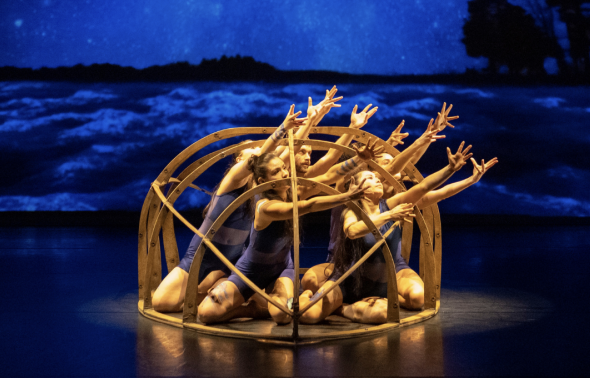
The set, designed by Julia Tribe, was simple, however it incorporated a few key pieces for dancers to interact with. For example, the boat used to display travel is made up only of key structural boning, becoming almost cage-like when flipped upside down. Dancers were able to move into, out of, and around it in a variety of ways. Without giving away too much, I also thoroughly enjoyed the use of a rolling stool that was used to differentiate the way a particularly fearsome character moved around the stage. Finally, Lesley Hampton’s costume design was sleek and neutral, so as to not take away from the performers on the stage. I especially appreciated this when I saw the set pieces and other ways dancers interacted with one another in the show, as their costumes never caught on each other or their surroundings.
Miigis was a beautiful contemporary dance performance, one that left me eager to learn and know more about the histories and stories which inspired it. Although its time in Kingston was short, I encourage those who missed it to seek out Miigis and other productions by Red Sky in the future – especially before they complete their Ontario tour at the end of this month.
‘Miigis: Underwater Panther’ was presented by Red Sky Performance, and played at the Kingston Grand Theatre on November 17th, 2026. Tickets and more information can be found here.