A Sharp Play Packed with Twists
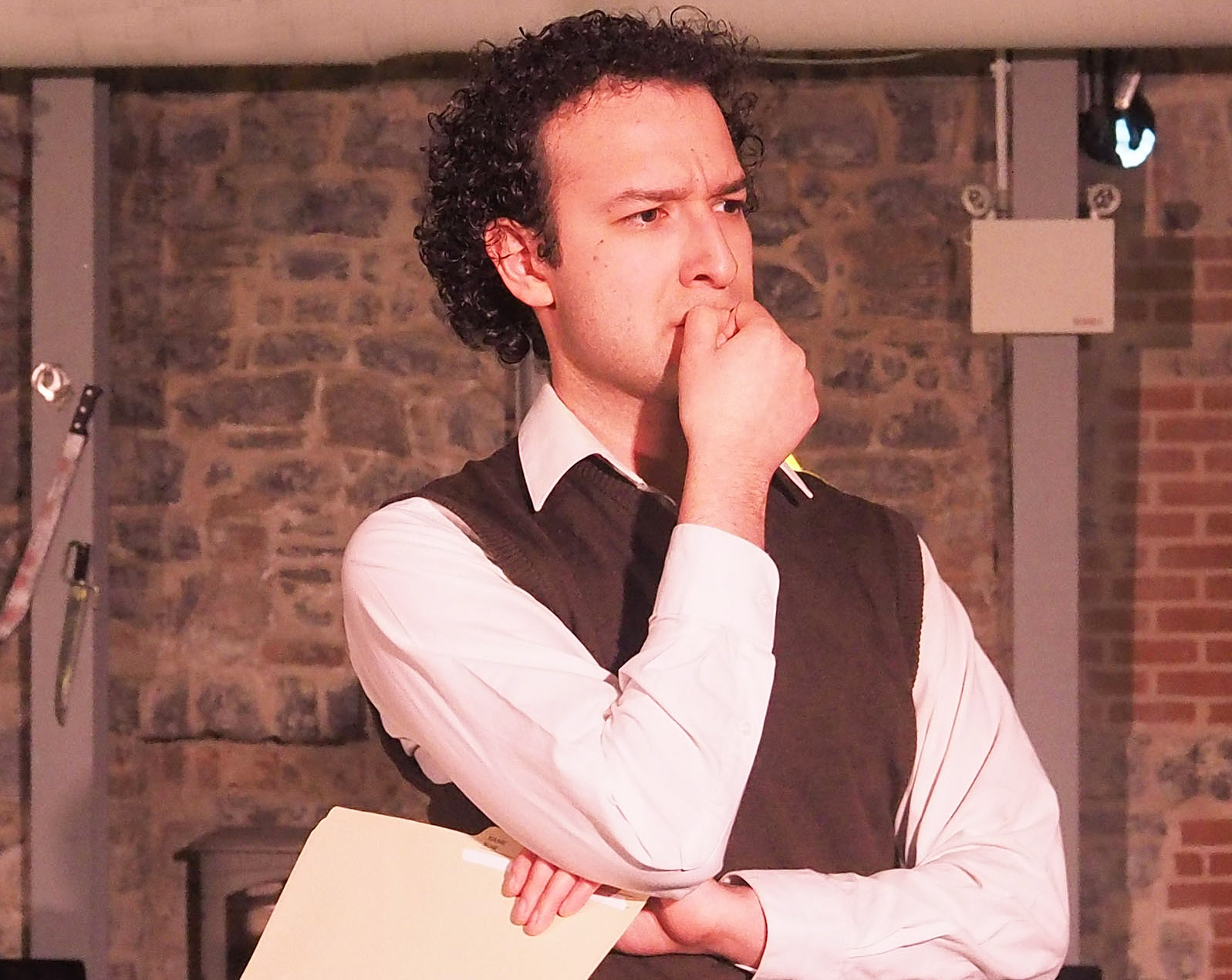
“Careful, it’s sharp!” comes the warning from one of Deathtrap’s five characters, and while it’s meant to caution against the cutting steel of a weapon, the descriptor could just as easily apply to the play itself.
Deathtrap, a 1978 play written by Ira Levin, is Queen’s Theatre Troupe (QTT)’s latest production. Co-directed by Myra Chiu and Alfonsina, the dark comedy contains multiple twists and turns that are just as likely to make audiences gasp as it is to make them laugh.
As the audience enters the Tett Rehearsal Hall, they are greeted by bebop jazz and an actor already on stage going about his business—always an appreciated choice to make for any stage without a proscenium arch or curtains. The thrust stage is furnished with a desk, couch, bar cart, and a gallery wall of murder weapons, and Pierce Lindsay’s set design effectively places us inside the study of a suspense writer. No part of the detailed set is superfluous; each item—from the colourful crochet throw on the couch to the cozy woodburning stove—serves a purpose.
Alastair Leong’s lighting design walks the fine line between serious and satirical. On one hand, table and floor lamps supply diegetic lighting for the evening scenes, grounding these moments in reality. On the other, the occasional use of spotlighting and vivid red tints veer more into the realm of the cliché. But with a play as self-referential as Deathtrap, I’m inclined to believe this is an intentional decision designed to contrast the realism of some moments with the darkly comedic absurdity of others.
Beneath Leong’s lights and on Lindsay’s set, there are only five actors in this production, and each stands out upon their own merits. There is Sydney Bruhl, the once-successful playwright played by Gael Salas; Myra Bruhl, his loving wife played by Charli Birdgenaw; Clifford Anderson, the up-and-coming playwright played by Will Mercer; Helga ten Dorp, the eccentric psychic next door played by Alayna Sider; and Porter Milgrim, the Bruhls’ lawyer played by Piper Clapp.
Sydney is the first character we meet, on stage even before the metaphorical curtain rises, and he remains on stage for almost the entirety of the show. While the first few minutes of Salas’ performance were rocky—some misspeaks and falters that weren’t breezed by casually enough to ignore—the stammering, sometimes unintelligible cadence of his voice made his performance of a struggling writer all the more believable, albeit sometimes difficult to parse. Despite this, Salas plays a manipulative narcissist with such accuracy that I genuinely found myself hoping it really was just an act. To clarify, I do mean that as a compliment.
Mercer experienced the same opening-night, opening-line stumbles, but the rust was shaken off quickly enough that those small errors were eclipsed by his disarming and charming portrayal of Clifford. Birdgenaw’s Myra is adorable and cheeky, and she does a wonderful job differentiating her acting from ‘acting as Myra’ and ‘acting as Myra acting.’
Gaïa Adjemian’s costume design features some gems, my personal favorite being that of Sider’s Helga. The moment Sider steps on stage, it is immediately clear this is the Bruhls’ psychic neighbour. Something about the black feather boa, gaudy beaded necklaces, and fringed coat really communicates ‘strange, vaguely-European lady’ right off the bat. Sider’s excellent physical performance brings the costume to life, balancing out the fact that her accent comes and goes. The costume design is enjoyable enough that it’s easy to look past any anachronisms. Clapp’s Porter, for instance, wears a smart pantsuit that underscores her well-acted confidence as a lawyer, but I do happen to own the exact same outfit, which begs the question: is my wardrobe five decades out of date, or are the costumes a bit too modern? Regardless, the play is a thriller chock full of plot twists and melodrama, so its verisimilitude is far from the most important thing.
While there were some minor issues that pulled me away from the show—questionable proficiency with a rotary telephone, the empty Corona bottles, the use of clear liquid for brandy, and the mispronunciation of “garrotte” from a character who works with words for a living, to name a few—the main challenge faced by QTT during this production was the space itself. During the first five minutes of the play, a fan was going so loudly the actors had to shout to be heard, but luckily once it turned off it never turned back on. The stone walls of the Tett’s Rehearsal Hall make sound bounce and echo, sometimes muddying the dialogue, but it also means that uneasy moments feel extra tense, making the quiet click of handcuffs loud as a death knell.
The production also had to contend with the other occupants of the Tett. In the second act, the drum practice next door gave the scene a rhythmic sense of momentum—like watching a Steven Soderbergh movie when the plan starts coming together—but it didn’t mesh so well when the steady drum beat turned into a spicy samba.
Regardless of the small blips, QTT’s Deathtrap is without a doubt worth the short trek to the Tett. Go in as blind as possible, and don’t be shocked when you audibly gasp.
Queen’s Theatre Troupe’s production of ‘Deathtrap’ is playing at the Tett Centre Rehearsal Hall from March 24-28, 2026. Tickets can be purchased at the door, or online here.