Balance is the Soul of ‘W;t’
In the quiet darkness of a theatre before the stage lights go on, the squeaky wheels of an IV pole are our first introduction to Dr. Vivian Bearing. “It’s not my intention to give away the plot,” she tells the audience in an opening monologue that immediately breaks the fourth wall, “but I think I die at the end.”
W;t, written by Margaret Edson and directed by Martha Bailey, is Domino Theatre’s first show of 2026. The play, which won the 1999 Pulitzer Prize for Drama, is set during the final hours of Dr. Vivian Bearing’s life after a battle with ovarian cancer. Vivian, played by the talented Helen Bretzke, is a professor of seventeenth-century poetry with a particular love of John Donne’s Holy Sonnets. Her recent diagnosis has forced her out of the lecture hall and into the hospital, where it becomes evident from her complete lack of visitors that Vivian pursued research at the expense of forging genuine human connection.
From the jump, Tim Fort’s set and lighting design ground the performance in reality. The hospital room—consisting of a bed, two small shelves, and three chairs—is walled in by horizontal blinds with soft lighting peeking through. Medical imaging procedures are mimicked with sudden switches in lighting and accompanying sound effects, designed by Anthony Kaduck, that are familiar to anyone who has ever found themselves inside an MRI machine. Jen Buder and Loren Smith’s costume design lend to the verisimilitude of the production; the doctor wears a doctor’s coat, the nurse wears scrubs and colourful clogs, and the overall accuracy of the costuming allows the audience to focus on the heart of the play; the life and death of Vivian Bearing, PhD.
“Less than two hours,” Vivian tells the audience at the start, “and then curtains.” The one-act play runs for 90 minutes, clipping along at an efficient pace, and Bretzke is on stage for every moment. It is a demanding role to play, but Bretzke does it beautifully. From the proud stance of a scholar at the top of her game, to the playful, bouncy ease of a child, and finally, to the defeated defiance of a strong woman brought low by disease, Bretzke embodies the character of Dr. Vivian Bearing wholly as we get glimpses into various moments throughout her life.
Despite Vivian’s general loneliness in life, there is a strong supporting cast of characters who are with her both in the hospital, and in the memories she takes us through.
We are first introduced to her doctor, Harvey Kelekian, played by Grant Buckler, as he diagnoses her with stage IV metastatic ovarian cancer. In the next memory, Kelekian is replaced by Dr. E.M. Ashford, played by Mary-Jo Maur, who was Vivian’s academic mentor. The nearly identical blocking of these two memories place Dr. Kelekian and Dr. Ashford in direct comparison with each other as they deliver bad news to Vivian; one is a potentially terminal diagnosis, the other is a criticism of her understanding of Donne’s Holy Sonnet X, but both ultimately alter the trajectory of Vivian’s life.
Alongside Vivian in the hospital, there is also nurse Susie, played by Jen Atkinson, and clinical fellow Jason, played by Christian Milanovic. Susie is all heart, making up for her limited vocabulary with the genuine compassion everyone wants from their primary nurse. Jason, on the other hand, is an intellectual with no bedside manner whose preference of research over humanity reflects Vivian’s own. Milanovic is especially endearing as the young doctor, stumbling through small talk as he gives his former professor a pelvic exam, and offering a simple thumbs up before leaving conversations he wants no part of.
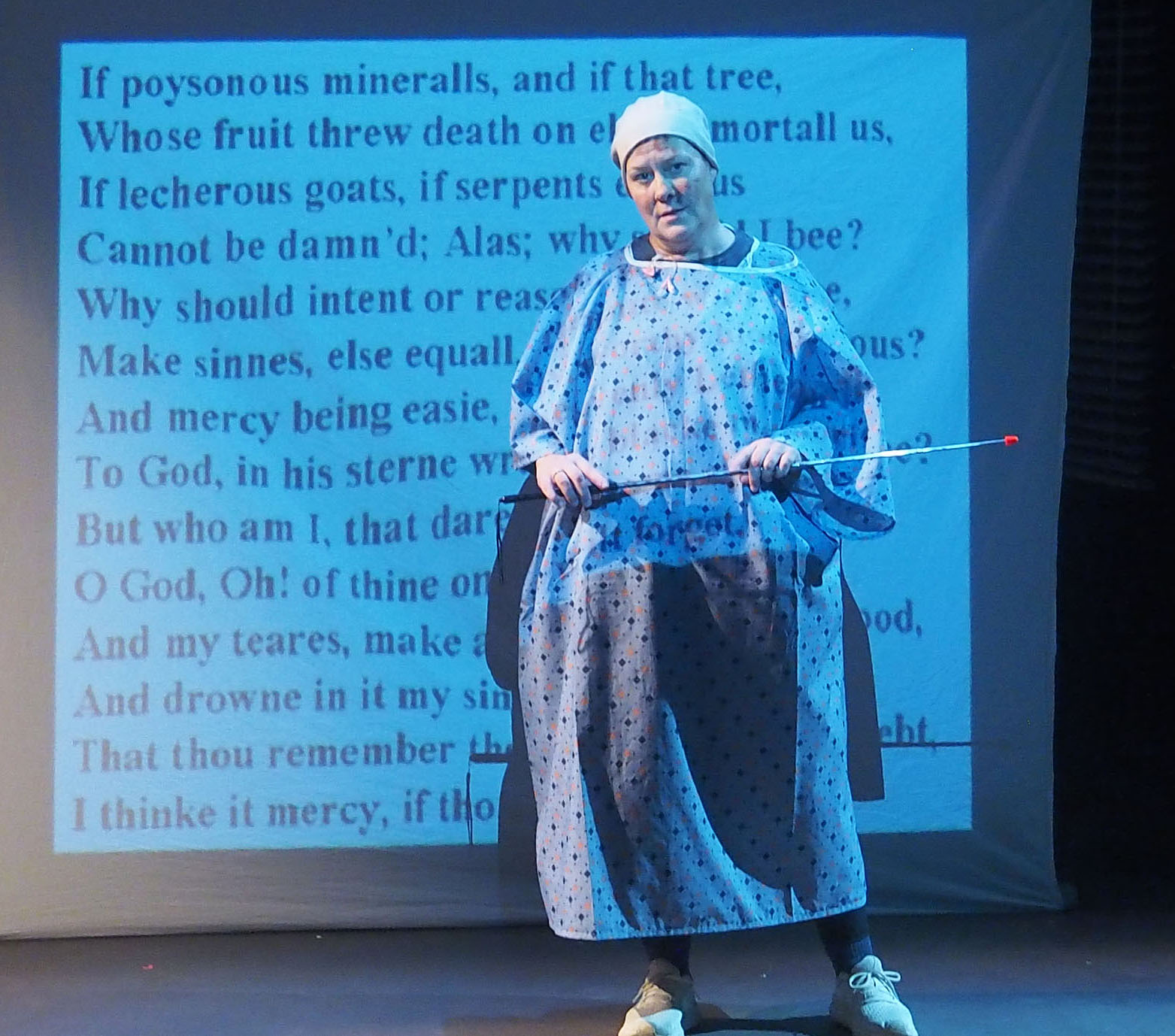
Underscoring the entire production, like a line beneath the words you wish to emphasize, is the work of John Donne, the seventeenth century metaphysical poet to whom Vivian dedicated her studies. His writings, which contain irony and paradox abound, shape the way Vivian looks at the world around her. At one point, in a wonderfully creative use of light and prop work, Vivian lectures the audience on Donne’s Holy Sonnet IX. She projects her lecture slide onto a white hospital bedsheet, held taut by nurses in scrubs. This elegantly blends her career with her sickness, entwining Donne’s poetic contemplation of death with Vivian’s own.
W;t is a play that demands its cast walk a tightrope between humour and tragedy. It is a delicate balancing act, but with Bailey’s direction and Brezke’s incredible control of tone, they manage to pull it off.
‘W;t’ is playing at the Domino Theatre from January 15 – 31 at the Davies Foundation Auditorium, 52 Church St. Tickets and more information can be found here.