‘Hands in her Pockets’: Three Strong Voices
Content warning: this review and show touches upon the topic of suicide and substance abuse. Telephone Aid Line Kingston has representatives trained to provide support and resources to those in Kingston and the surrounding area.
Please note this review contains strong language.
“Being brought up properly is a fucking handicap,” the Deaf performer signs on stage. It’s one of many humorous moments of Hands in her Pockets, a play written and directed by Rosemary Doyle of Theatre Kingston, produced in collaboration with Deaf Spirit Theatre, and inspired by the similarly-titledStones in his Pockets by Marie Jones.
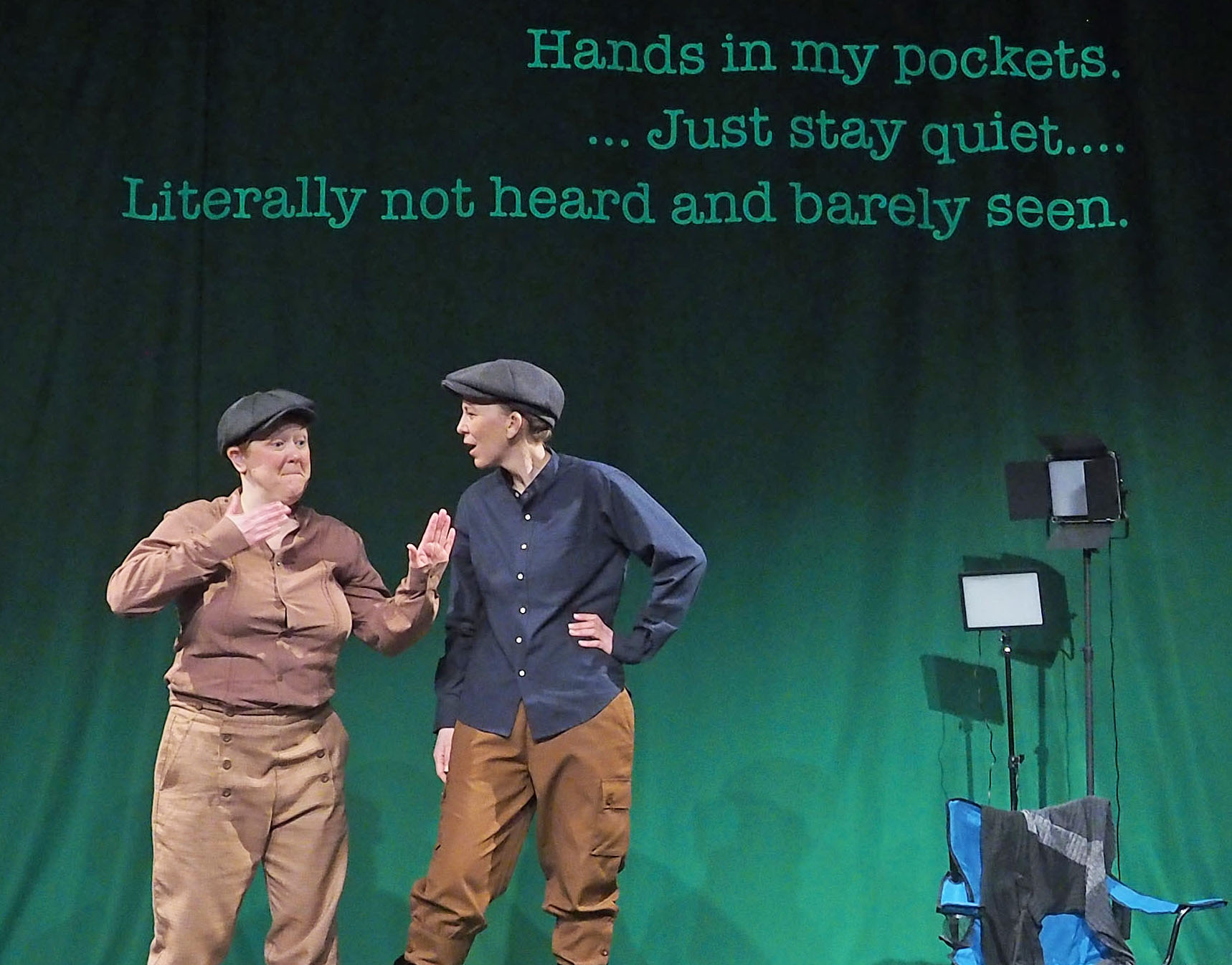
The play revolves around the experiences of Janey Quinn, played by Elizabeth Morris, and Fiona Conlon, played by Hayley Hudson, who are two Deaf actors working as extras on a film taking place in Potato-Famine-era Ireland, but shot in Frontenac County. The third and final actor on stage is Lauren Lafayette Brooks, who plays multiple characters: Aisling, the film’s frustrated First Assistant Director (AD); Nicola, the movie’s star; and Sean, Janey’s unhoused and drug-addicted cousin. With this small cast of characters, the three performers lead the audience through the hurdles Deaf actors are forced to navigate to pursue their dreams.
American Sign Language (ASL) is the show’s primary language, and in the deft hands of Morris and Hudson, the lines are communicated with more expression than if they had been spoken. Surtitles are provided for the ASL impaired, projected onto the green screen that is hung across the back of the stage. Each character has their own font—sans-serif for Janey, serif for Fiona—which helps differentiate whose line is whose. The surtitles also include images and emojis, which, while sometimes humorous, are often redundant given the larger-than-life expressions of Morris and Hudson. If you’re a fast reader, you might also find yourself racing through the text before the actors have finished their first line, but that isn’t ever a problem—it gives you time to watch their performances.
The show’s production design (lighting by Will Smith-Blyth) makes it easy to immerse yourself in the world of the characters. Ambient noise fills the silence left by the lack of spoken dialogue, with outdoor noise and soft crowd chattering switching to ambient bar music and conversation from one scene to the next. The accompanying set is simple and familiar. There’s a grassy mound of earth in the centre, with which the actors are able to play with levels, and two camping chairs—one red, one blue—in the corner of the stage. With the audience’s eyes so often fixed upon the screen to read, scene transitions are done seamlessly, with a table and two pints of beer seemingly appearing out of thin air.
While the design is solid, it’s the acting that stands out here. Hudson’s laughter is boisterous and truthful, and her later anger simmers so strongly I could feel it from the back row. Morris’ movements—ASL or otherwise—are larger than life. It’s particularly fun to watch her sign the expression, “pissing against the wind,” or mistakenly decapitate two audience members with her mimed samurai sword skills.
Brooks has the most to juggle, and she does it admirably. A particularly stunning moment is when Nicola (played by Brooks) gets into an argument with Aisling (also played by Brooks) offstage, and the audience listens to her flip effortlessly between a Canadian and quite-convincing English accent as she argues with herself—all while doing a quick costume change. First AD Aisling engages with the audience the most, treating them as though they are extras on the set as well. She often makes direct eye contact with audience members to ensure they’re listening to instructions, and she even introduces the play’s intermission by telling us that we’re all allowed to take a 15-minute break before we need to get back to set.
I am impressed not only by the acting, but by the small-yet-poignant moments nailing home the show’s themes. If you’re familiar at all with the basic premise of Jones’ original play, you know that (spoiler) a local teenager commits suicide by drowning himself with stones in his pockets. With that knowledge, you cannot help but draw a comparison between the two titles and wonder, if stones in his pockets killed him, in what way does hands in her pockets kill her? Then the First AD repeatedly scolds the two Deaf extras for talking animatedly with their hands, and as she tells them to keep their hands in their pockets, the answer becomes clear: to silence someone is to kill them.
Kingston audiences will enjoy the local references, but when we laugh at the jokes, part of me wonders if the actors know. It occurs to me that much of how I behave as an audience member (I’m quite good at gasping, laughing, and sucking in a quick breath at particularly tense moments) would be lost on an actor who cannot hear my reactions. So much of stage acting is working with the energy generated by the audience, but how much of that energy is lost in translation?
And translation—turning Stones in his Pockets into Hands in her Pockets, turning Frontenac County into rural Ireland, turning English into ASL—is one of many themes being tackled by this play. There are also the topics of homelessness, drug addiction, famine, accessibility issues, and Deaf representation in film; it’s a lot for any play to handle, and sometimes it feels like they bit off more than they can chew. That feeling isn’t helped by an ending that is a tad rushed, with the crux of the play—disabled people should be able to tell their own stories—getting spelled out a bit heavy-handedly.
But those flaws pale in comparison to the play’s many triumphs, and the only real issue I had was that no amount of suspending my disbelief can make me believe a movie star would willingly drink Tim Horton’s coffee. Whether it’s for the comedy or the commentary, I’d recommend seeing this novel and innovating show if you can.
‘Hands in her Pockets’ is playing at the Grand Theatre from March 12-21, 2026. For more information and to get tickets, click here.