Finn Again Wakes: ‘A Dream Play’ Returns After 25 Years
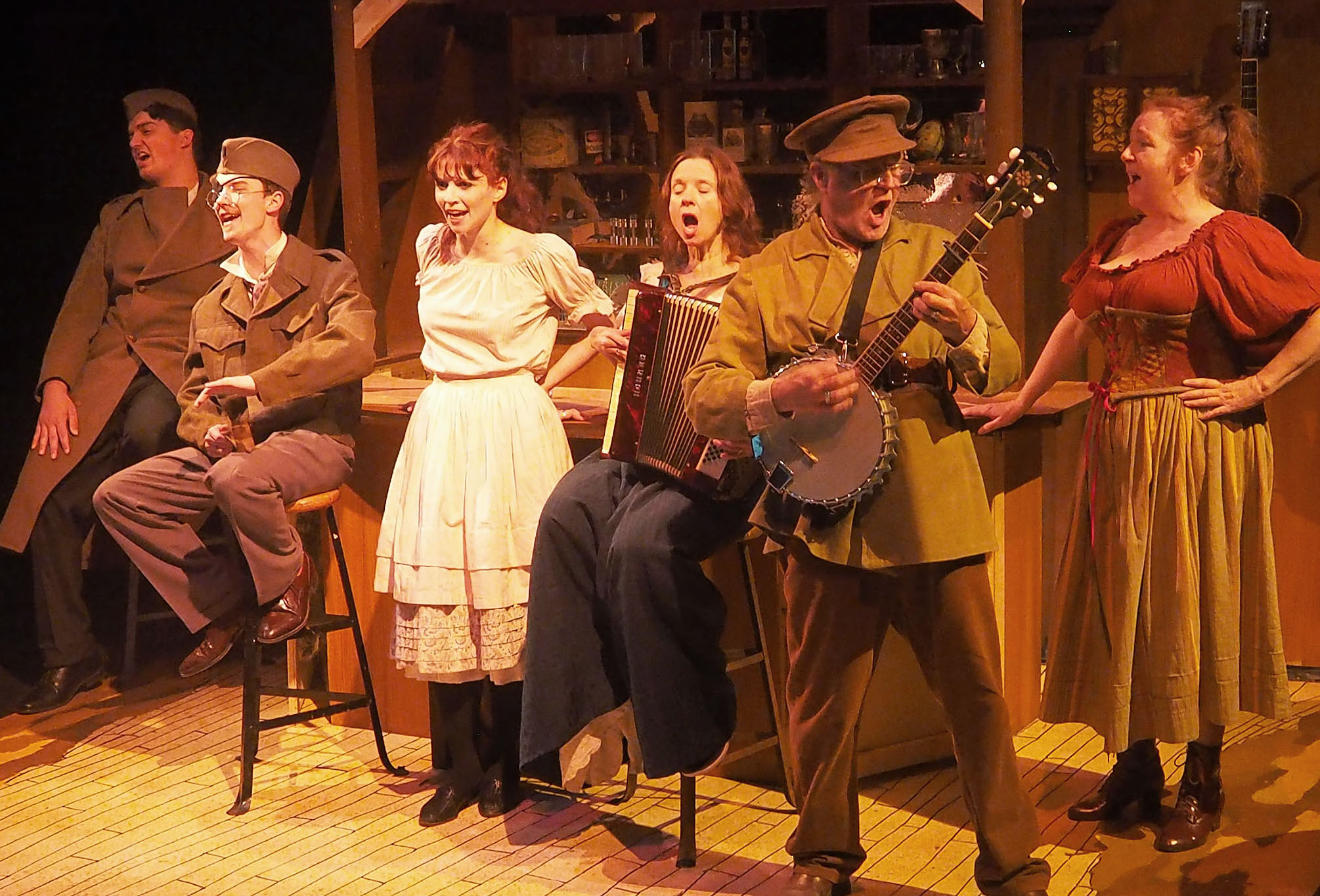
How do you review a dream? When you blearily blink back into wakefulness, is it better to critically engage with your slumbering mind through a psychoanalytical Freudian lens, or that of an English major attempting to establish a story structure? Perhaps a bit of both, with a healthy amount of neither.
James Joyce’s 1939 novel Finnegans Wake reads like a dream, radical and baffling to the point where nearly a century later, some scholars still cannot even agree who the main character is. Naturally, a theatrical adaptation would likewise bewilder any audience expecting a linearly structured story. Presented by Theatre Kingston, and written and directed by Craig Walker, Finnegans Wake: A Dream Play returns to the Baby Grand 25 years after its Kingston premiere, ready to once again leave audiences rolling with laughter and furrowing their brows.
Sean Roberts plays the show’s lead, a slumbering man stumbling through his dreams and called many names, but most often referred to as HCE. Roberts brings a humorous curmudgeonly energy to HCE that is endearing, looking more like a man unwillingly tangled up in some perplexing family drama than a sleeping father caught up in his own dreams. Accompanying Roberts is Melissa Morris as ALP—or Anna Livia Plurabelle—who might be HCE’s guide, his wife, or maybe even the river Liffey itself, upon whose swerve of shore and bend of bay Dublin was built. Morris stands like a lighthouse amidst the turbulent dreamscape, always lucidly poised to navigate HCE through the confusion.
Twins Shaun and Shem are played by Aiden Robert Bruce and Jake Henderson, respectively, and their opposing natures are often a source of comedy as the brothers bicker. Their sister Izzy is played by Siobhán McMahon with a balanced degree of innocence and maturity, and the cast is rounded out by Kevin Head and Rosemary Doyle, who both acted in the show’s original 2001 run.
The cast has a diverse wealth of musical talent. While some are more vocally proficient—Aiden Robert Bruce showcases the baritone that has led to them performing opera in Croatia—others demonstrate dexterity with the banjo, guitar, and accordion. While I caught one or two moments where a line was sung early or swapped with a later verse, the confidence of the actors paired with the surreal nature of the play itself allowed the blips to be brushed past with ease.
The surreality is further embellished by the strong and cohesive production design led by Tim Fort (lighting), Andrea Roberston (set and costume), and Clelia Scala (puppet designer and creator). For the set, the alley stage is transformed into the interior of an Irish pub, with a full bar at one end and the stained glass door and windows at the other. These windows later serve as screens onto which different scenery can be projected or bodies can be silhouetted against, providing a shadow-puppet method of communicating some of the naughtier moments.
The puppetry itself is a nice, tactical touch to a dreamlike play that often feels just out of grasp—you might not fully understand why there is a green phallic cake, a giant talking stone face, or a pair of ant and grasshopper marionettes, but at the very least you know they are tangibly there. Also unignorably present are the wild plethora of costumes; despite a cast of only seven, there are costumes for promiscuous ladies, aristocratic gentlemen, soldiers, uniformed students, a king, a postmaster, a game show host, birds who are also bearded men in papakhas, and of course, a set of pyjamas. As the players morph from one character to the next, so too does their physicality, with Henderson particularly standing out for his uncanny portrayal of an eagle’s movements.
Considering the alley set and the near constant involvement of actors while on stage, there is hardly any opportunity for the cast to disappear into the background. They know this, and make use of it wonderfully, milking the comedy of small gestures passed between each other for every laugh they can get while whoever is in the metaphorical spotlight focuses on delivering the dialogue that drums on delightfully. “Here we rejoice,” says Head, “for here we read Joyce.”
And rejoice indeed, because the script bubbles with puns, alliteration, and sentences that don’t end in rhymes but feel like they ought to. Held carefully entwined amongst the witticisms and design details are the overarching themes of colonization and the cyclical structure of time, featured most obviously in the name of the bar, Oroboro. For anyone wanting to approach this play with a critical lens, there is an abundance of material to delve deeper into, just as there is with Joyce’s original text.
If you aren’t the kind of audience who enjoys close examination or textual analysis, fear not—the remarkable thing about Finnegans Wake:A Dream Play is that it is exceedingly enjoyable whether or not you’re studying it like a scholar. The most important thing for audiences to know is this: you are not mishearing the words, and the actors are not mispronouncing the words—just trust your ears and go with it. The lines are brilliant if you pay close attention, and if you don’t, they still sound lovely, their sentences tumbling along like a barrel bobbing on the Liffey.
‘Finnegans Wake: A Dream Play’ runs from May 21 to June 7 at the Baby Grand Theatre. For tickets and information, click here.